Manila, Philippines, 1 May 2026 – Three UK-funded ASEAN-UK Green Transition Fund (GTF) activities convened during ASEAN Climate Week 2026 to advance integrated climate solutions across Southeast Asia, spanning nature-based approaches, inclusive climate finance, and pathways to just transition. Two of these activities were delivered as part of the official ASEAN Climate Week 2026 programme, while a third complementary activity was convened with the goal of developing a report on financing just transition strategies, which will be published in partnership with the Philippine Chairship.
UK Ambassador to ASEAN Helen Fazey said:
“ASEAN Climate Week 2026 comes at a significant moment as we mark five years of the UK as an ASEAN Dialogue Partner. Our partnership is built on delivering practical, ASEAN-led solutions to shared challenges. Through the Green Transition Fund – the flagship programme of the UK Mission to ASEAN – we are supporting action on nature-based solutions, climate finance, and inclusive energy transitions that strengthen resilience and protect livelihoods across Southeast Asia. The UK looks forward to continuing this close collaboration with ASEAN and its Member States as the region advances its climate ambitions towards COP 31.”
“We convene at a critical moment, ASEAN Member States have raised ambitions through updated NDCs but the urgent challenge before us is implementation: translating commitments into policies, programmes and investment-ready projects that deliver measurable outcomes for our people. From ASEAN Climate Week, we expect clear usable outputs, each share summary on accelerated climate action and regional resilience.”
— Atty. Juan Miguel T. Cuna, Acting Secretary, Department of Environment and Natural Resources (DENR)
From 27 April to 1 May 2026, the ASEAN-UK Green Transition Fund (GTF) convened three high-level activities as part of ASEAN Climate Week 2026, a regional forum co-hosted by the Philippine Department of Environment and Natural Resources (DENR) under the Philippines’ ASEAN Chairship for 2026. Through the GTF’s implementing partners, these activities brought together government officials, civil society organisations, climate finance institutions, and regional bodies to advance integrated climate action across Southeast Asia’s priority sectors.
The activities, delivered under the GTF’s Nature-based Solutions (NbS) and Climate Policy and Institutional Capacity Development pillars, reflect the UK Government’s continued commitment to supporting ASEAN’s own climate priorities through targeted funding, technical expertise, policy engagement, and long-term partnership with ASEAN institutions and Member States.
Biodiversity as climate solution: demonstrating interlinkages across the region
On 27 April, the ASEAN Centre for Biodiversity (ACB) hosted a moderated panel discussion, ‘Demonstrating Biodiversity and Climate Change Interlinkages in the ASEAN’. The discussion, co-organised with the Philippine’s Department on Environment and Natural Resources (DENR) and supported through the GTF-funded Enhancing Conservation and Restoration of Wetlands and Peatlands in ASEAN as Effective Sinks and Reservoirs of Greenhouse Gases (EnCORE Wetlands) project, brought together policymakers, academics, civil society organisations, and regional project representatives in a hybrid format.
The discussion addressed the urgent need for unified regional action against the ‘triple planetary crisis’ of climate change, biodiversity loss, and pollution. Panellists underscored that Southeast Asia’s rich biodiversity, including tropical peatlands, mangrove forests, and inland forests, represents not only an asset under threat, but a powerful, practical solution to regional climate vulnerability.
ACB Executive Director Jerome Montemayor shared how rising sea levels, shifting rainfall patterns, and the increasing frequency and strength of extreme weather events continue to threaten food and nutrition security, livelihoods, and the safety of millions. “Southeast Asia is one of the most vulnerable areas to the impacts of climate change. Despite also being threatened, healthy and resilient ecosystems are our best line of defense, providing layers of protection from the harmful impacts of disasters and climate change. They safeguard communities, store carbon, and anchor our economic and social well-being,” said Montemayor.
Exploring pathways for scaling climate finance in Southeast Asia
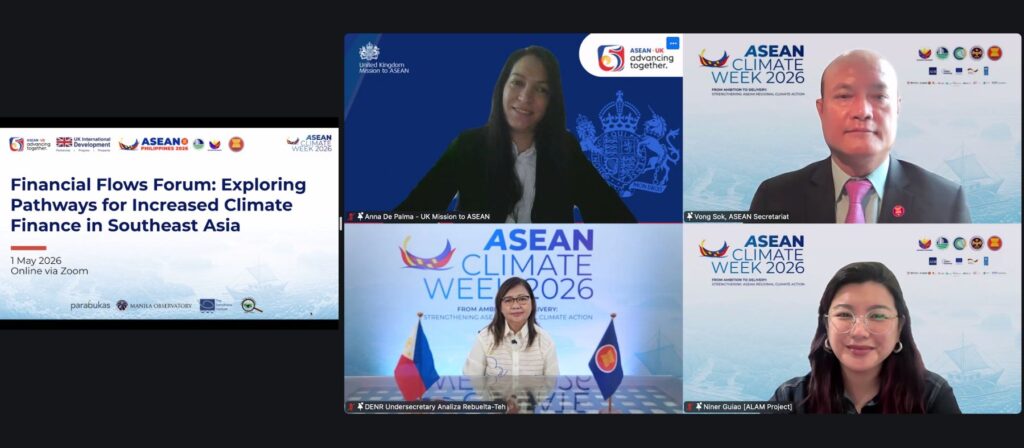
On 1 May, the “Advancing Learning and Capacities in ASEAN on Mitigation: Financing and Nature-postiive Just Transition” (ALAM) Project convened a virtual financial flows forum: Exploring Pathways for Increased Climate Finance in Southeast Asia, bringing together representatives from ASEAN Member States, the ASEAN Working Group on Climate Change (AWGCC), ASEAN Centres, financial institutions, and civil society to explore strategic opportunities for increasing climate finance flows in the region.
‘’The outcomes of today’s forum, the synthesis of our discussions, and the refinement of our project concept note will set the stage for the next decade of climate action in the ASEAN.
Together, under the banner of partnership for progress and prosperity, we can ensure that Southeast Asia remains not just a witness to the green transition, but a leader of it,” said Atty. Analiza Rebuelta-Teh, Undersecretary for Finance, Information Systems, and Climate Change, Department of Environment and Natural Resources
Two roundtable discussions anchored the forum. The first examined access to climate finance and investment mobilisation for NbS, with a focus on the ASEAN Investment Framework on Haze-Free Sustainable Land Management (AIF-HFSLM) and the development of a multi-country Green Climate Fund (GCF) concept note on haze-free landscape ecosystem management. The second explored the potential for ASEAN Centres to pursue GCF Direct Access Entity accreditation, drawing on comparative experience from Caribbean Regional Accredited Entities and the GCF Secretariat.
Despite Southeast Asia’s acute vulnerability to climate impacts, there remains a significant gap in climate finance for the region to deliver its climate commitments. Forum participants identified concrete steps to close this gap, including through decentralised access mechanisms and strengthened regional institutional capacity.
Civil Society Organisation (CSO) Dialogue on climate finance and the ASEAN Joint Statement
Also on 27 April, civil society organisations from across Southeast Asia convened in Manila for the Regional CSO Dialogue for an inclusive and just transition in Southeast Asia. While convened outside the formal ASEAN Climate Week 2026, the dialogue was convened with the goal of developing a report on financing just transition strategies which will be published in partnership with the Philippines Chairship Organised by ALAM project under the GTF, and delivered in support of the Philippines ASEAN Chairship’s agenda, the dialogue brought together frontline CSO voices to gather insights and recommendations on just and inclusive transition in Southeast Asia.
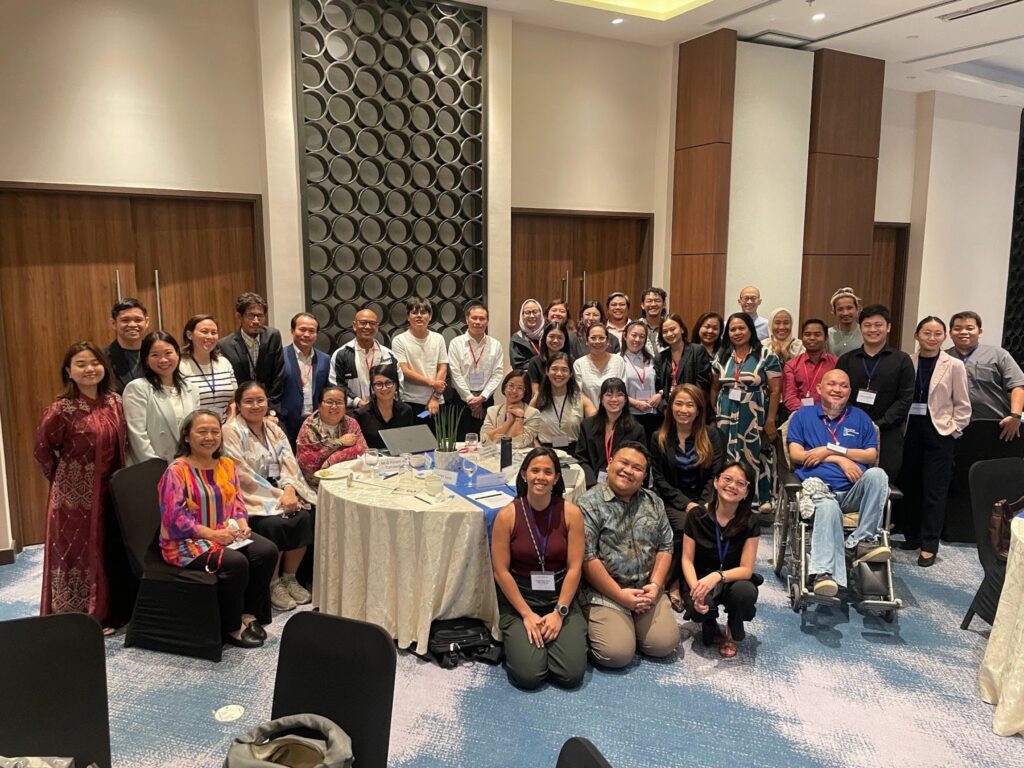
‘’Today’s discussion provides an important opportunity to bring together national and regional CSOs to share insights and learn from the experience of tackling climate change and biodiversity and advancing an inclusive and just transition in ASEAN. Addressing these challenges requires collaboration and bold and innovative solutions. CSOs play a central role in driving effective and equitable action. ASEAN has recognised CSO contributions in its climate initiatives.’’, said Anna De Palma, UK Mission to ASEAN
Participants shared experiences of accessing climate finance for mitigation initiatives, identified barriers to inclusive and rights-aligned climate action, and contributed substantive input on gender equality, disability and social inclusion (GEDSI) and human rights considerations for regional climate action. The dialogue underscored that the climate finance requirement for Southeast Asia by 2030 cannot be met without meaningful engagement and resourcing of civil society actors, particularly amid an increasingly constrained global aid environment.
“As ASEAN Chair, the Philippines steps in at a time when climate risk is no longer episodic, shaping food, water, energy, and economic stability. The transition we pursue is not only about sustainability, but about resilience, security, and long-term competitiveness”, said Secretary Robert E.A. Borje, Vice Chairperson and Executive Director, Climate Change Commission of the Philippines
These complementary activities demonstrate that durable inclusive impact in Southeast Asia depends not just on isolated interventions, but also integrated, regionally-owned partnerships – an approach the UK continues to champion through dialogue partnership with ASEAN and the member states.
###
About the ASEAN-UK Green Transition Fund
The ASEAN-UK Green Transition Fund (GTF) is the UK Mission to ASEAN flagship programme to accelerate ASEAN’s transition to a clean and climate resilient economy by reducing emissions in key sectors, supporting green economic growth, and improving livelihoods of vulnerable people. It provides technical assistance activities throughout the region, targeting all eleven ASEAN Member States (AMS).
About the ALAM project
The Advancing Learning and Capacities in the ASEAN on Mitigation: Financing a Just and Nature-Positive Energy Transition (ALAM) Project is implemented by a Southeast Asia-based consortium comprising the Manila Observatory, Parabukas Pte. Ltd., The Samdhana Institute, and Core Group Transparency – Timor-Leste, with funding from the UK through ASEAN-UK GTF programme.
About the EnCORE Wetlands project
The EnCORE Wetlands Project is implemented by the ASEAN Centre for Biodiversity (ACB), with support from the UK through the ASEAN-UK GTF programme. The project works to protect and restore carbon-rich peatlands and wetlands across the ASEAN region, advancing simultaneous climate mitigation, habitat conservation, and community livelihood outcomes.
Media contacts:
ALAM Project:
Antonio La Vina, Project Lead, Manila Observatory
Cecilia Therese Guiao, Deputy Project Lead, Parabukas
EnCORE Wetlands:
Michael Jaldon, Project Manager