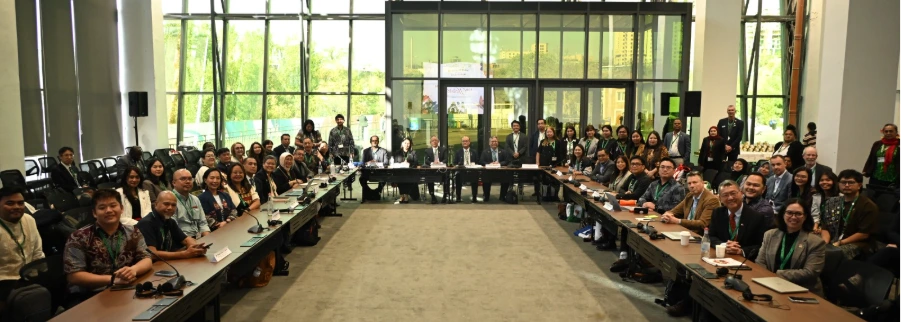
YEREVAN, Armenia – Reaffirming its steadfast commitment to transformative, inclusive, and urgent action for nature, the ASEAN, through this year’s Chair, the Philippines, the Ministry of Natural Resources and Environmental Sustainability of Malaysia, the ASEAN Secretariat, and the ASEAN Centre for Biodiversity (ACB) convened a high-level panel discussion on 26 October, on the sidelines of the 17th UN Biodiversity Conference.
Opening the event, ACB Executive Director Jerome Montemayor recalled how the ABP, the region’s own strategic roadmap to implementing the Kunming-Montreal Global Biodiversity Framework (KMGBF), was launched at the previous UN Biodiversity Conference in Cali, Colombia. “Halfway through the 2030 deadline, we are gathered here to assess how ASEAN is faring in translating this blueprint into policies and measurable actions on the ground,” Dr. Montemayor said. “The theme of CBD COP17, ‘Taking Action for Nature’, underscores an urgent truth: fulfilling our KMGBF targets demands rapid, transformative, and whole-of-society action,” he continued. The ACB likewise serves as one of the 18 regional and subregional technical and scientific support centres for the implementation of the KMGBF in Asia.
Representing the ASEAN Secretariat, Dr. Vong Sok, Assistant Director of Sustainable Development and Head of the Environment Division, said that in order to achieve the ASEAN Community Vision 2045, the region must treat biodiversity as a cross-cutting priority across health, climate, and diverse ecosystems. He added that strong capacity building and active engagement with key stakeholders like youth and the private sector can help meet regional goals. met through strong capacity building and actively engaging with key stakeholders, such as engagement with key stakeholders like youth and the private sector.
From global to regional perspectives
The side event was divided into three main parts. The first segment featured high-level leadership perspectives from Jillian Campbell, Senior Advisor at the Office of the Executive Secretary of the Convention on Biological Diversity (CBD), Mary Chakreeyan, Legal Adviser of the Ministry of Environment of Armenia, National Focal Point to the Aarhus Convention, CBD COP17 Presidency, and Atty. Ernesto Adobo, Jr., Undersecretary for Legal, Organizational Transformation and Human Resources of the Department of Environment and Natural Resources from the Philippines. The panellists reflected on what the biodiversity agenda must deliver next and how the ASEAN Member States (AMS) can work together to achieve these goals.
Jillian Campbell of the SCBD lauded ASEAN for having its own regional biodiversity roadmap; establishing a regional monitoring strategy, maintaining the ASEAN Clearing-House Mechanism to support countries with planning and decision-making and publishing the ASEAN Biodiversity Outlook to report how the ASEAN Member States help achieve global biodiversity targets.
Representing the ASEAN 2026 Chair, the Philippines, Atty. Ernesto Adobo, Jr., emphasised that transformative action for nature is not about choosing between development and biodiversity. It is about recognising that sustainable development relies on healthy and resilient ecosystems. “The world does not need another decade of good intentions. It needs a decade of delivery. Let us therefore move from ambition to action, from action to impact, and from individual efforts to collective leadership,” he added.
What have we achieved so far?
The Secretariat of the CBD has recently published the global report on the collective progress in the implementation of the KMGBF.
Since its launch in 2022, parties, including the ASEAN Member States, have committed to aligning national targets, strategies, and plans with the KMGBF. Substantial steps have been made, and these have included actors other than national governments: Indigenous Peoples and local communities, women, youth, intergovernmental organisations, and other key players. However, evidence from the global report has identified gaps and barriers that, if not urgently addressed, would hinder our ability to reach our 2030 targets and, consequently, our 2050 goals as well.
The panel discussions have highlighted various concerns, challenges, and opportunities faced by ASEAN member states in achieving regional and global biodiversity goals. The dialogue focused on area-based conservation, invasive alien species management, access and benefit sharing, digital sequence information, and traditional knowledge, innovations, and practices. This segment tackled ensuring equitable benefit-sharing and the meaningful participation and leadership of Indigenous Peoples and local communities.
During the panel discussions, Indonesia shared about its efforts in preventing and managing Invasive Alien Species (IAS), including its Global Environment Facility-supported project that was designed to help meet KMGBF Target 6 by reducing IAS by at least 50%. Additionally, Thailand shared that it has established a national Access and Benefit-Sharing (ABS) framework to complement the Nagoya Protocol and to give local communities a platform to voice their perspectives whenever genetic resources are requested from their areas.
In addition to representatives from the ASEAN Member States (AMS) and other parties to the CBD, Indigenous Peoples and local communities, women, youth, the private sector and other key stakeholders also participated in the side event.
Emphasising the global recognition of the critical role of Indigenous Peoples and local communities in biodiversity conservation, Gawis International Rights Inc. Executive Director and UN Permanent Forum on Indigenous Issues Member Atty. Jennifer Tauli Corpuz shared that the Global Environment Facility has committed 20 per cent of its portfolio to go to actions led by indigenous peoples and local communities. Representing ASEAN youth, Ignatius Baxter Sagong Anak Nair from the Global Youth Biodiversity Network shared the importance of investing in people. “We are not asking for charity; we are offering a partnership. We bring the passion, the networks, and the resources that we already have to contribute to ASEAN biodiversity priorities,” he said.
From resources to results
The second panel part focused on resource mobilisation, innovation, and strategic partnerships to accelerate the region’s biodiversity priorities. This included private sector action, biodiversity financing, knowledge management, and youth-led mobilisation.
Recognising how their businesses are deeply interconnected with nature and seeing how protecting nature is the foundation of resilient businesses, Metro Pacific Investments Corporation (MPIC) Executive Director and Chief Finance, Risk and Sustainability Officer June Cheryl Cabal-Revilla highlighted the importance of integrating sustainability, resilience, risk management, and finance in their business and investment decisions.
Coming from the same sector, SD Guthrie Chief Sustainability Officer Rashyid Redza Anwarudin shared their current initiatives in relation to nature and biodiversity conservation. “As one of the largest producers of certified sustainable palm oil globally, SD Guthrie’s operations are inherently dependent on nature. However, we also recognise that our operations have an impact on nature. Because of this, we have been implementing a few initiatives across our global supply chain,” he shared. One of the current initiatives SD Guthrie is working on with the WWF is regenerative agriculture practices in Sabah.
Representing the Technical Assistance Facility to the Green Team Europe Initiative (TAF-GTEI),Asih Budiati shared the results of a study on innovative financing across the AMS, including but not limited to REDD+, Payment for Ecosystem Services, among others. “The results point out a clear message: innovative biodiversity finance is not about finding one perfect instrument but about combining the right financing mechanisms with sound governance, credible environmental outcomes and meaningful community benefits. If we get these elements right, ASEAN can move beyond financing individual projects towards sustaining healthy ecosystems, resilient communities and long-term biodiversity outcomes,” she said.
In his closing remarks, Mr. S. Siva Kumar, Undersecretary of the Biodiversity and Forestry Management Division of the Ministry of Natural Resources and Environment, Malaysia, reaffirmed a crucial truth. “Collective action, inclusive dialogue, and strategic partnerships across our region are not just valuable; they are indispensable for realising the transformative change called for by the KMGBF and for advancing the ABP,” he said. “Let the ASEAN spirit of cooperation, our drive for inclusion, and our pursuit of transformative progress be the enduring legacy of this gathering,” he concluded the side event.
With support from the European Union through TAF-GTEI, the UK Mission to ASEAN through the ASEAN-UK Green Transition Fund, SD Guthrie, and MPIC, the side event was a platform to showcase ASEAN initiatives, regional platforms, and collaborative partnerships that contribute to accelerating implementation of the Kunming-Montreal Global Biodiversity Framework (KMGBF) through the ASEAN Biodiversity Plan (ABP). It was likewise a chance to identify opportunities for enhanced international cooperation, knowledge exchange, financing, innovation, and technical collaboration.