News, Events, and Opportunities

  • Messages
  • ASEAN Biodiversity and Nature-Based Solutions to Climate Change

    Message of ACB Executive Director Dr.Theresa Mundita Lim during the ACB & Manila Observatory Partnership Launch

    2 October 2023

    To the honourable Secretary of the Department of Environment and Natural Resources and former Executive Director of Manila Observatory,  Secretary Maria Antonia Yulo-Loyzaga,\

    Fr. Jose Ramon T. Villarin, S.J.

    Executive Director of Manila Observatory,

    Dr. Antonio La Viña, Corporate Secretary of the Board of Trustees of Manila Observatory, Associate Director for Climate Policy and International Relations, and current Head of its Klima Center,

    And to all  our allies in communicating biodiversity and climate change, our media partners,

    Good morning!

    In 2010, a friend of mine did their field work in Palanan, Isabela after Typhoon Megi, one of the strongest typhoons that year, hit the northeastern part of Luzon. He took several photos of the destruction. A month later, my friend, Leonard Co passed away, and a year after, his brother-in-law, Darwin Flores trekked back to Palanan to honour Leonard’s legacy. What Darwin saw was a recovering ecosystem, beginning to teem with life and diversity. The forest could not have been restored by humans, as the area was not easily accessible by land.  

    It was thus concluded that it was the wildlife that took shelter in the least affected part of the Sierra Madre that were responsible for the replanting and regeneration. 

    This story, I thought, was a good example of how climate change and biodiversity are intertwined. Climate change impacted the biodiversity of Sierra Madre, but healthy biodiversity also recovers easily and so provides the function of resiliency.

    Moreover, with these shared ecosystem goods and services, The ASEAN region can leverage the cooperation among its member states for its socio-economic development.

    Biological diversity is not just diversity in species but also in ecosystems. While we are fortunate to be enjoying this natural wealth, the ASEAN region is beset by the worsening impacts of climate change. Every year, we are seeing how the series of typhoons can exact a heavy toll on human lives, livelihoods, and economies. 

    Southeast Asia remains one of the vulnerable regions, being among the most disaster-prone in the world, with 1,218 disasters occurring from 2012 to 2018, data from the ASEAN show.

    Data from the World Meteorological Organization, in its Global Annual to Decadal Climate Update Target years: 2023 and 2023-2027 says:

    • The chance of at least one year between 2023 and 2027 exceeding the warmest year on record, 2016, is very likely (98%). 
    • The chance of the five-year mean for 2023-2027 being higher than the last five years (2018-2022) is also very likely (98%).
    • The chance of global near-surface temperature exceeding 1.5°C above pre industrial levels for at least one year between 2023 and 2027 is more likely than not (66%).
    • The El Niño Southern Oscillation (ENSO) is predicted to most likely be positive in December to February 2023/24.

    Climate change is one of the main drivers of biodiversity loss. Because of the range of temperatures that different species can withstand, species and ecosystems have evolved to flourish in particular environments. Due to the continued rise in temperature brought by climate change, some species that could not migrate or adapt to this drastic temperature rise may go extinct. 

    Species loss, on the other hand, reduces our natural defense against the detrimental impacts of climate change.

    Climate change and biodiversity loss are part of the triple planetary crises. Both concerns should be tackled together since they both pose a threat to our basic survival. 

    While climate change is one of the drivers of biodiversity loss, biodiversity, through protection, ecosystem restoration and conservation, are nature-based solutions that are a crucial part of climate action. 

    The Kunming-Montreal Global Biodiversity Framework (KM GBF) recognises the need for climate change mitigation and adaptation. Target 8 of the KMGBF says:

    Minimise the impact of climate change and ocean acidification on biodiversity and increase its resilience through mitigation, adaptation, and disaster risk reduction actions, including through nature-based solution and/or ecosystem-based approaches, while minimising negative and fostering positive impacts of climate action on biodiversity. 

    In addition, the ASEAN Leaders during the 43rd ASEAN Summit in Jakarta, Indonesia expressed the importance of promoting nature-based solutions to protect biodiversity as a post-pandemic recovery and enhance the resilience of the ASEAN region against zoonotic diseases, addressing climate change, and facilitating regional contributions to the KM GBF. 

    The diversity of ecosystems found in the ASEAN all serve as various layers of protection against climate change impacts. Mangrove ecosystems have been widely promoted as natural buffers against storm surges, and indeed it is. The region is also composed of a variety of coastal and marine ecosystems, such as beach forests, seagrass beds and tidal flats, not to mention near shore coral reefs that act together as systems of natural break waters against large and strong sea waves. 

    Healthy coral reefs can absorb up to 97 percent of a wave’s energy, buffering coastal communities from storms and associated waves, flooding, and erosion. 

    Wetlands such as marshes and mangroves protect coastlines by dampening storm surge and waves; they also prevent erosion and can build new land. 

    Ocean habitats such as seagrasses and mangroves can also sequester carbon dioxide from the atmosphere at rates up to four times higher than terrestrial forests can. Their ability to capture and store carbon make mangroves highly valuable in the fight against climate change.

    Almost 2 million square kilometers of lakes, rivers, freshwater swamps, marshes, streams, and other inland waters and wetlands can be found in the ASEAN region. Out of the region’s 57 ASEAN Heritage Parks (AHP), 9 are wetlands, occupying approximately 684,000 hectares. Wetlands are known to be the most effective carbon sinks on the planet, storing twice as much carbon as all the forests.

    The ASEAN has at least 12 forest types which serve different functions, some like pygmy forests serve better in areas vulnerable to strong winds, while forests with large dipterocarps are effective in absorbing large amounts of rainfall to help prevent sudden rise of water level in flood-prone areas. 

    Species diversity in trees and wildlife is also key to more resilient ecosystems, and the genetic diversity in wild foods can be valuable sources of disease-resistant and pest-resistant protein and have valuable potential for food productivity.  


    The ASEAN region is rich in biological resources and natural heritage. We have 25 percent of all known plants and animals species despite only possessing 3 per cent of the world’s land area. The species endemic to the ASEAN region is 37 per cent. We also have a vast shoreline of 173,000 km.

    Three of the ten countries are considered megadiverse countries, five are part of the Indo-Burma Region, which is considered one of the wealthiest regions in the world, in terms of biodiversity. Singapore is globally known for its sustainable, green city that has allowed a rich variety of wildlife to thrive and survive within an urban setting.  And a large part of Brunei, and portions of Indonesia, and Malaysia are what is known to be among the world’s key centres of biological diversity, the heart of Borneo. These vast resources contribute to the basic needs– such as food, water, clean air, and resilience against natural disasters  —  of  661.5 million people of the ASEAN region. 

    Moreover, unusual observations in wild species in their natural habitats can be natural early warning systems, before impacts on human populations can be felt. Unique characteristics and behaviour in nature can also serve as inspiration for technology and innovations.

    All these can be described as solutions based on nature or what most call as nature-based solutions. It should be clear though that the way we use the term refers to the actions that work with and enhance nature to help address societal challenges and that the concept is grounded in the knowledge that healthy natural and managed ecosystems produce a diverse range of services on which human well being depends.

    The example that I have given earlier, in the Sierra Madre Mountains, is a good example of a nature-based solution to the impacts of climate change. It is one of the most important protected area systems in the Philippines’ eastern seaboard that serve as our natural shield against extreme weather conditions. 

    Protected areas are at the core of these nature-based solutions.  Healthy ecosystems are more resilient to climate change. Ecosystems contribute to climate solutions. Pristine marine and terrestrial areas serve as carbon sinks. Mangroves, apart from its many services, cushion the impacts of storm surges and strong waves.

    Currently, the ACB is supporting the conservation and management of protected areas through its ASEAN Heritage Parks (AHP) programme, a flagship program of the Centre which enhances the protection and capacity building of protected area managers, staff, and park rangers in both terrestrial, marine and wetland ecosystems. To date, there are 57 declared AHPs in the ASEAN region. 

    In the Philippines, the Protected Area Management Board of Mount Apo Natural Park has  involved the local tribe of Bagobo-Tagabawa in forest conservation activities. 

    Mt. Apo Geothermal Power Plant operates within the Mt. Apo National Park, one of the ASEAN Heritage Parks in the Philippines. It provides cheap, clean and stable power to meet the economic growth of Mindanao while providing payment for ecosystem services to the indigenous tribal groups and carrying out reforestation efforts to ensure that watershed protection that sustains the steam that powers the geothermal energy in addition, The same watershed is habitat to the endemic Philippine eagle, and all the other species associated with it. 

    In Indonesia, the collaborative management of Kepulauan Seribu National Park was instrumental in local empowerment. Coastal communities became vanguards of marine biodiversity, particularly the coral reefs and sea turtles. This was made possible through the Kampung Iklim (Proklim) which also provided income opportunities to local communities through ecotourism and mangrove conservation projects.

    The case of Bukit Timah Nature Reserve and Sungei Buloh Wetland Reserve in Singapore demonstrates a case of ecosystem restoration, through ANR. In addition to the serious and sustained reforestation efforts of the local communities, the National Parks Board (NParks) of Singapore closed the park for two years (2014-2016) to allow natural regrowth. They conducted a study by comparing the data before and after the closure. The results showed forest recovery and improvement in soil conditions. Both nature parks are recognised as NBS to “cushion the impact of urbanisation and mitigate the effects of climate change.”

    The  ACB recognises assisted natural regeneration or ANR as an effective NBS, thus, to complement natural forest recovery, the ACB  implements the ASEAN Green Initiative (AGI),  a 10-year campaign for ecological restoration in the region. It is the first region-wide native tree planting programme aiming to plant 10 million trees across the 10 AMS for a period of 10 years. 

    The programme puts emphasis on native tree species for planting since they are likely to survive in their natural environment and are more sustainable in the long term. Native trees are well adapted to the climate and soil, hence they are more resilient and have a higher rate of survival. 

    Planting and growing native trees could enrich biodiversity and help revive the natural interactions between organisms and species of both flora and fauna. 

    In the “Natural Climate Solutions hierarchy”, protecting intact ecosystems has the highest potential for mitigation, followed by management of working lands, and lastly restoration. 

    Preventing the loss of stored carbon by protecting ecosystems is estimated to be about twice as effective globally as restoring lost or damaged ecosystems (around 4 GT CO2 per year compared to 2 GT CO2 per year for restoration). 

    Moreover, the gradual accumulation of carbon from restoration cannot compensate, in a timely way, for the rapid emission of large amounts of carbon from deforestation and degradation. 

    Protecting intact ecosystems, especially old-growth forests, also brings the greatest benefits for biodiversity and local communities (including supporting climate change adaptation) and has the lowest risk of impermanence.

    Last year in Montreal at the CBD COP 15, in my conversation with Sec Yulo about downscaling global data that will be useful for enhancing NBS and ecosystem-based adaptation at the regional level, she brought our attention to CORDEX and the work of the Manila Observatory.  Today,  we begin to make things happen.

    Through our partnership with Manila Observatory, we aim to demonstrate through modelling and visualisation, the inextricable link between climate change and biodiversity. We want to provide a platform to harmonise efforts, exchange knowledge, and build capacity of practitioners so as to contribute to the achievement of both regional and global biodiversity and climate targets. And, we hope to come up with evidence-based information that will help us effectively and sustainably harness our God-given natural wealth, our rich and unique biodiversity in the Philippines and, in the ASEAN,  to protect us from the adverse  and increasing effects of a warming planet.

    Explore More

    partners

    IMA World Health is a leading public health organisation that delivers solutions to health-related problems across the developing world. The organisation works with local partners and governments to strengthen existing health systems, prevent and treat diseases, improve maternal and child health, promote nutrition and WASH, and contribute to global health security. 

    Learn more about IMA World Health here: https://imaworldhealth.org/

    The EU also plays a leading role in international efforts to promote sustainable development. Environmental challenges do not stop at borders. More action is needed globally to ensure clean air, oceans and other water resources and to ensure that land and ecosystems are used sustainably and that climate change is kept to manageable levels.

    Learn more about the European Union here: https://op.europa.eu/webpub/com/eu-what-it-is/en/#chapter2

    The Metro Pacific Investments Corporation (MPIC) is a Philippine-based investment management and holding company registered with the Philippine Securities Exchange Commission. It is a leading infrastructure holding company with a diverse set of assets held through operating companies. Through acquisitions and strategic partnerships, MPIC  seeks to create value by upgrading infrastructure, improving operational efficiency, increasing customer coverage and working closely with regulators and other partners in government.

    Learn more about MPIC here: https://www.mpic.com.ph/about-us/our-company/

    Known as one of the world’s leading promotional banks, the KfW Development Bank is committed to improving the social and economic living conditions of people around the world, while promoting environmental and ecological sustainability. On behalf of the Federal Government of Germany and the federal states, the KfW provides financial support to governments, public enterprises, and commercial banks in developing countries.

    Learn more about KfW here: https://www.kfw-entwicklungsbank.de/International-financing/KfW-Entwicklungsbank/

    Field visit

    Hosted by Viet Nam, a field trip is scheduled at Ha Long Bay, a UNESCO World Heritage site. It is recognised for its geological and geomorphological value due to the development of karst limestone formations over billions of years. These limestone features are the result of Earth’s tectonic deformation, uplift, erosion, weathering, and sea level changes. Ha Long Bay also represents one of the areas where sea level changes have occurred throughout Earth’s evolutionary history from the Cretaceous period to the present. Thus, Ha Long Bay serves as a living record of global climate change. It also exemplifies the interaction between geological and biological processes, creating a rich and diverse ecosystem

    Programme

    parallel sessions

    Co-organised with the European Union through the Technical Assistance Facility to the Green Team Europe Initiative (EU-GTEI)

     
      • Nature-based Solutions (NbS) are actions to protect, sustainably manage and restore natural and modified ecosystems in ways that address societal challenges effectively and adaptively, to provide both human well-being and biodiversity benefits. This underpins the benefits that flow from healthy ecosystems and targets major challenges like climate change, disaster risk reduction, food and water security, and health are critical to economic development. 

        This interactive session will explore how Nature-based Solutions (NbS) can be scaled and adapted across ASEAN Heritage Parks (AHPs) to enhance biodiversity conservation, climate adaptation, and community resilience. Using the ASEAN NbS Platform as a foundation, the sessions will connect landscape-based NbS strategies with the unique ecological and cultural contexts of AHPs.

    Subtopics and Speakers:

    Introduction to Nature-based Solutions in ASEAN Heritage Parks Landscape Strategies for Climate Action through Implementation of NbS in and around AHPs

    Introduction to Nature-based Solutions in ASEAN Heritage Parks Landscape Strategies for Climate Action through Implementation of NbS in and around AHPs

    Mr. Sebastien Goethals

    NbS, Spatial & Landscape Planner Expert

    Co-designing and Financing NbS Pilot Projects in ASEAN Heritage Parks

    Mr. Alvin Lopez

    Head of Nature Solutions Finance Hub, ADB (TBC)

    Ms. Domiliza Campaner

    Park Superintendent

    Pasonanca Natural Park, Philippines

    Ms. Elisabet Rismauli Wahyuni

    Park Manager

    Lorentz National Park, Indonesia

    Mr. Nguyen Hoang Minh Hai

    Head of Scientific Research and

    International Cooperation Dept

    Tram Chim National Park, Viet Nam

    co-organised with IMA World Health

    • Date & Time: 3 December 2025, 13:30 – 17:00
    • Venue: Thanh Lân 1 (1st floor)
    • Target Participants:  National Focal Points (ACB Governing Body, AWGNCB), AHP Park Managers and their partners, and other government agencies working in biodiversity conservation, wildlife management, public health, agriculture, and environmental protection, and community, academe and private sector partners engaged in One Health, zoonoses, prevention, and sustainable wildlife management
    • AHP 8 – Session 2 – Concept Note


      • The increasing prevalence of zoonotic disease underscores the need for integrated approaches to managing health risks at the interface of humans, animals, and ecosystems. This urgency was reinforced during the CBD COP 16 with the adoption of the Global Action Plan on Biodiversity and Health. This milestone document promotes preventive, ecosystem-based strategies to address key drivers of zoonotic disease, including habitat loss, illegal wildlife trade, and unsustainable wildlife management. In Southeast Asia,  the ACB plays an active role in implementing these principles, having been involved in the development and implementation of the ASEAN One Health Joint Plan of Action (ASEAN OH JPA) following the ASEAN Leaders Declaration on One Health in May 2023.  Furthermore, the ACB also fosters regional collaboration and capacity-building initiatives by integrating One Health principles into conservation strategies across ASEAN Member States. 


        This session will highlight how ASEAN, through the AHP Programme and its wider biodiversity agenda, is contributing to the implementation of the KM GBF. It will also showcase progress on mainstreaming One Health principles into conservation strategies, identify opportunities for cross-sectoral collaboration, and explore innovative pathways for cooperation in line with the goals of the KM GBF and the ASEAN Biodiversity Plan. The session will include the subtopics indicated below and will feature experiences and perspectives from the following speakers and panelists:

    Subtopics and Speakers/Panelists

    Biodiversity, Health, and Emerging Risks: The Global and Regional One Health Landscape

    Dr. Jerome Montemayor

    Executive Director

    ASEAN Centre for Biodiversity

    Dr. Mardi Caniban

    Bureau of Animal Industry

    Department of Agriculture

    Philippines

    Ms. Viny Sutriani

    One Health Focal Point

    Ministry of Health

    Indonesia

    Ms. Yang Shufen

    Sungei Buloh Wetland Reserve

    Singapore

    Advances and Future of One Health through a Whole-of-Society Approach

    Mr. Oliver Agoncillo

    Director

    Mainstreaming Biodiversity Division

    Programmes Department

    ACB

    Dr. Melbourne Talactac

    Chairman

    One Health University Network

    Philippines

    Ms. Niken Salindri

    Program Manager for the

    One Health Collaborating Centers

    One Health University Network

    Indonesia

    Ms. Nga Nguyen

    One Health Team Leader


    Wildlife Conservation Society

    Representative Office in Viet Nam

    Mr. Elliott James Ong

    Co-Founder

    Pasarfish

    • Organised with ACB’s Small Grants Programme II
    • Date & Time: 3 December 2025, 13:30 – 17:00
    • Venue: Yên Đức (2nd floor)
    • Target Participants: AHP stakeholders (youth, members of the indigenous people group), AHP sites that have active participation of youth, and IPLCs 
      • The Indigenous Peoples, Local Communities (IPs and LCs), youth, and women have critical contributions in advancing biodiversity conservation and achieving the Biodiversity Plan. Their stewardship, traditional knowledge, and leadership are essential for strengthening ecosystem resilience, promoting biodiversity-friendly livelihoods, and ensuring that conservation actions are inclusive and sustainable. Building on the ACB’s efforts to integrate these groups into policy and practice, the session builds on these efforts, showcasing lessons learned, strategies, and good practices for fostering meaningful partnerships and inclusive participation in protected area management, biodiversity governance, and conservation action across ASEAN.
    •  

    Subtopics and Speakers

    Championing Biodiversity Conservation: Recognising Indigenous Peoples, Local Communities, Youth, and Women as Nature’s Stewards

    Mr. Muhammad Nur Hisham bin Busra

    Park Warden

    Endau-Rompin Johor National Park, Malaysia

    Ms. Nadia Putri Rachma Persada

    Regional Co-Coordinator

    Global Youth Biodiversity Network SEA

    Dr. Lerma SJ Maldia

    Professor, Department of Forest Biological Sciences / 

    Director, Makiling Center for Mountain Ecosystems

    University of the Philippines Los Baños Laguna,

    Philippines

    Enhancing conservation efforts through the meaningful participation of Indigenous peoples, local communities, youth, and women: The Case of the Small Grants Programme (SGP)

    Dr. Nguyen Hoang Hao

    Director of Dong Nai Nature and Culture Reserve

    Deputy Head – Dong Nai World Biosphere Reserve

    Management Board

    Ms. Sarah Grace  Ancheta

    M&E Officer

    ASEAN Centre for Biodiversity

    Mr. Muhammad Abdul Syukur

    Director of Penabulu Foundation

    Ms. Lina Warlina

    AHP Manager representative

    Way Kambas National Park

    Ms. Ho

    Ayun Commune Representative

    Ms. Ms. Nguyen Thi Ngoc Lan

    Director

    Center for Water Resources Conservation and

    Development (WARECOD)

    Ms. Wai Mon Thet

    Range Officer

    Nature and Wildlife Conservation Division,

    Forest Department

    Co-Creating Inclusive Approaches to Protected Area Management and Biodiversity Conservation

    • Date & Time: 4 December 2025, 08:30-12:00 
    • Venue: Yên Đức (Second floor)
    • Target Participants: NBSAP planners, protected area authorities, AHP managers and staff implementing or planning restoration initiatives, private sectors or academe engaged in restoration, species-site matching, and biodiversity monitoring
    • Concept Note
     
      • Various efforts from ASEAN Member States and the ACB’s TSCC country parties proactively address this concern through their NBSAP and national commitments to eradicate and reverse degradation. The ASEAN Heritage Parks and the ASEAN Green Initiative exemplify the best practices in ecosystem restoration, enhancing and protecting the integrity of the ecosystems. Ecological restoration and rehabilitation in AHPs demonstrate effective protected area management for the protection and maintenance of the habitat of important species, while the ASEAN Green Initiative showcases the best people-led reforestation initiatives in private lands, urban settings, key biodiversity and various landscapes. These restoration initiatives showcase inclusivity in restoration. The session highlights ASEAN’s best practices in scaling up Target 2 and Target 3 of the KM GBF through its flagship programmes, AHP and the AGI. 

    Subtopics and Speakers

    Key Note Speaker:

    Ms. Zhuo Cheng

    Food and Agriculture Organization (FAO)

    From Global Goals to Local Actions: Policy, Planning, and Governance for Protected Area Restoration

    Ms. Nancy R. Corpuz

    Chief, Ecosystems Management Specialist

    Biodiversity Management Bureau

    Department of Environment and Natural Resources

    Philippines AWGNCB

    Mr. Sulistyanto

    Policy Analyst

    Directorate of Area Conservation

    Ministry of Forestry

    AHP Committee Member 


    Mr. Palber Turnip 

    Gunung Leuser National Park

    Ms. Somawan Sukprasert

    Environmentalist, Senior Professional Level, 

    Natural Resources and Environmental Policy and Planning

    Thailand AWGNCB

    Mr. Chalong Thongsong 

    Kraeng Krachan National Park

    Scaling up Restoration: Innovations and Tools in Restoration

    Ms. Abegail Y. Gatdula, RPF

    BINHI Program Lead

    Corporate Relations & Communications

    Energy Development Corporation

    Ms. Riina Jalonen

    Scientist 

    Alliance of Bioversity International and CIAT

    Dr. Joe Miller

    Executive Secretary and Director

    Global Biodiversity Information Facility (GBIF)

    Ms. Zhuo Cheng

    Food and Agriculture Organization (FAO)

    • Date & Time: 4 December 2025, 8:30 – 12:00
    • Venue: Thanh Lân 1 (First floor)
    • Target Participants: Technical Staff (national and local government agencies) handling protected area management, fisheries, environment, biodiversity, spatial planning, and natural resource governance; ASEAN regional bodies and technical working groups; Protected area managers and site-level practitioners; Scientists and researchers, academe, and students; Technology and data providers; and other stakeholders present during the AHP8 interested to know more about KMGBF Target 3
    • Concept Note
     
      • Achieving Target 3 of the Kunming–Montreal Global Biodiversity Framework (KM GBF) calls for conserving at least 30 per cent of the world’s land and sea areas through effective and inclusive management. Session 3: Strengthening Biodiversity Conservation – ASEAN’s Collaborative Contributions to the 30×30 Target will showcase the region’s collective efforts, key actions, and partnerships that advance biodiversity conservation. The session will emphasise on ASEAN’s collaborative approaches and innovative practices that help accelerate regional progress toward the achievement of Target 3.

    Subtopics and Speakers

    From Data to Decisions: Integrating Ecological Science and Stakeholder Realities to Achieve 30x30

    Vincent V. Hilomen, PhD

    Regional Fisheries Adviser

    ASEAN ENMAPS Project

    Sapto Aji Prabowo

    Director Conservation Area Management

    Ministry of Forestry, Indonesia

    Sheila G. Vergara, PhD

    Project Manager-Chief Technical Adviser

    ASEAN ENMAPS Project

    Shufen Yang

    Director

    Sungei Buloh Wetland Reserve, Singapore

    From Insights to Action: Strengthening AHP Management towards achievement of the 30x30 target

    Thien Le Quoc

    WWF – Viet Nam

    Carlo Paolini

    IMET Coach / Biodiversity and Governance Specialist

    Christian Elloran

    Director

    Biodiversity Informatics and Geospatial Analysis

    ASEAN Centre for Biodiversity

    Timothy John Pasicolan

    AHP Programme Associate

    ASEAN Centre for Biodiversity

    • Date & Time: 4 December 2025, 8:30 – 12:00
    • Venue: Thanh Lân 2 (First  floor)
    • Target Participants: Conference attendees invested in understanding financing gaps and opportunities in protected area management, including those involved in the planning and implementation of financing strategies, partnerships, plans, and policies addressing these gaps. 
    • Concept Note
     
      • Protected Areas provide ecosystem services that are critical for biodiversity conservation, climate change mitigation, ecosystem resilience, sustainable economic development, and improving human well-being. Effective protected area management is a critical tool in safeguarding these benefits.  Sustaining and scaling these efforts requires innovative approaches and sustainable sources of financing and resource mobilisation. 


        In Southeast Asia, financing for the development of protected areas is inadequate. Most of these PAs rely on traditional funding sources, which are the government, where funds are quite limited and unpredictable. PAs require a sustainable source of financing to support general administration, maintenance of buildings, vehicles, and equipment, law enforcement, species and habitat monitoring, scientific studies, outreach and awareness programmes, and tourism management. Mobilising adequate and sustainable financing is essential for meeting the goals of the Biodiversity Plan and ensuring long-term biodiversity conservation in ASEAN. 


        This session will explore how ASEAN can scale up resource mobilisation, while strengthening partnerships and financing strategies. Particular emphasis will be given to the AHP Programme as a platform for piloting and showcasing sustainable financing models that directly support protected area management, biodiversity-friendly livelihoods, and community participation. This session will highlight the best practices, opportunities, and lessons on how ASEAN can leverage sustainable finance to secure long-term conservation, protection, and resilience of its most important ecosystems.

    Sub-topics and Speakers

    Introduction (Overview): Importance of Sustainable Financing in Protected Area Management

    Ms. Kamille Rosales

    Biodiversity Finance Analyst

    Biodiversity Finance Initiative (BIOFIN) Global Team

    United Nations Development Programme

    Natural Capital Accounting and Valuation of Ecosystem Services: A Guide to Investments, Policy Decisions, and Financial Instruments in Protected Areas

    Mr. Ryan A. Cuanan

    Chief, Ecosystems Management Specialist

    Department of Environment and Natural Resources

    Best Practices and Lessons in Innovative Financing

    Mr. Aung Thant Zin

    Chief Executive Officer

    Myanmar Environmental Rehabilitation- Conservation

    Network (MERN)

    Ms. Joyce Panaligan-Quinan

    Senior Sustainability Manager

    Metro Pacific Investments Corporation

    Mr. Lennon Dungau Anak Remil

    Park Warden

    Gunung Mulu National Park

    Sarawak Forestry Corporation (SFC)

    Mr. Dzulhaili Bin Dzulkarnain

    Assistant Secretary

    Ministry of Natural Resources and

    Environmental Sustainability

    Mainstreaming Sustainable Financing to Biodiversity Conservation Plans and Policies

    Ms. Krystal Dayne Villanada

    Protected Area Superintendent

    Apo Reef Natural Park

    Mr. Komkrit Setbubpha

    Director

    National Park Research and

    Innovation Development Division

    Department of Natural Parks, Wildlife and

    Plant Conservation

    Mr. Pham Van Trung

    Senior Programme Officer

    Viet Nam Forest Protection and Development Fund

    (VNFF)

    Ministry of Agriculture and Rural Development

    Implementation of

    payment for Forest Environmental Services

    ACtivities

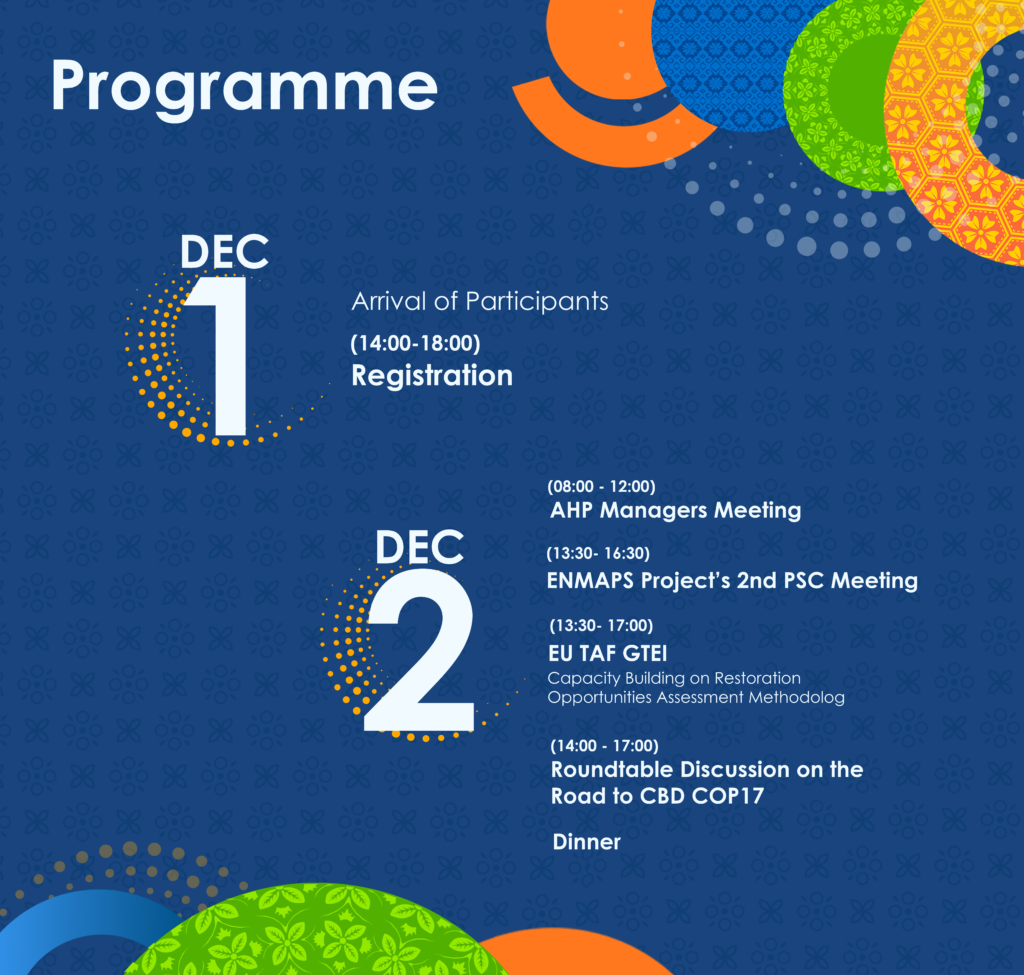
    Date & Time: 2 December 2025, 08:30 – 12:00

    Venue: Thanh Lân 2 (First floor)

    Target Participants: Closed session for AHP Managers and AHP Committee Members

    •  
      • This Meeting, which will convene the AHP Committee members, site managers, and park superintendents of the 69 protected areas under the AHP Network, will serve as a key regional platform for strengthening collaboration and coordination among the ASEAN Member States (AMS)  in the management and conservation of the AHPs. This Meeting will provide an opportunity for AHP managers to present accomplishments, challenges, and lessons learned in managing their respective parks, and will facilitate the exchange of knowledge, good practices, and innovative approaches towards effective protected area management. Moreover, it will serve as a venue to share relevant regional and national initiatives and explore opportunities for collaboration and capacity-building. Through these exchanges, the Meeting will enhance the resilience and sustainability of AHPs and support the ASEAN’s collective efforts to achieve the targets of the ASEAN Biodiversity Plan.
    • Date & Time: 2 December 2025, 13:30 – 16:30
    • Venue: Kim Quy (First floor)
    • Target Participants: Closed session for the ASEAN ENMAPS PSC
      • The ASEAN ENMAPS Project aims to enhance the management of coastal and marine resources in the large marine ecosystems of Indonesia, the Philippines, and Thailand. It is implemented by the ACB through the United Nations Development Programme, with support from the Global Environment Facility.
      • The Project helps strengthen Marine Protected Area networks and promote connected marine corridors through marine spatial planning, coastal management, and sustainable fisheries practices. It is coordinated nationally by the following organisations:
        • Ministry of Forestry (Indonesia)
        • Department of Environment and Natural Resources (Philippines)
        • Office of Natural Resources and Environmental Policy and Planning of the Ministry of Natural Resources and Environment (Thailand)
      • The Regional PSC was established to provide high-level oversight, strategic guidance, and approval of key project implementation decisions. The Second Regional PSC Meeting will be convened to provide an update on the implementation of the ASEAN ENMAPS. Specifically, the meeting aims to: 
      1. Seek guidance on the recommended actions following the results of the Project Implementation Review
      2. discuss concerns on project implementation at the regional, national, and site levels
      3. Seek approval of the 2026 work and budget plan, as well as the procurement plan
    • Date & Time: 2 December 2025, 13:30 – 17:00
    • Venue: Yên Đức (First floor)
    • Target Participants: Closed workshop for AHP Committee Members, AHP Site Managers and Staff, ASEAN Secretariat
      • This orientation session, co-organised with the European Union through the Technical Assistance Facility to the Green Team Europe Initiative (EU TAF-GTEI), will introduce ROAM to AHP Committee Members and the AHP Managers and Staff. ROAM is a diagnostic tool that provides a systematic and flexible framework for identifying, prioritising, and planning restoration interventions, facilitates the rapid assessment of landscape restoration opportunities and identification of specific priority areas at a landscape level. The session will also identify potential pilot sites among ASEAN Heritage Parks to use the ROAM. 
    • Date & Time: 2 December 2025, 14:00 – 16:00
    • Venue: Thanh Lân 2 (First floor)
    • Target Participants: Closed session for ASEAN Working Group on Nature and Conservation and Biodiversity, ASEAN Secretariat, and the ACB Governing Board Members


      • The 17th Meeting of the Conference of the Parties to the Convention on Biological Diversity (CBD COP17) and its Protocols is crucial for evaluating how the ASEAN Member States (AMS) are doing in following the Kunming–Montreal Global Biodiversity Framework. Hence, the AMS need to escalate actions in their National Biodiversity Strategies and Action Plans (NBSAPs) and prepare to submit the Seventh National Report (7NR). The CBD COP17 also presents an important opportunity for ASEAN to project a unified regional position on key biodiversity priorities through the ASEAN Joint Statement. The Joint Statement serves as a strategic tool to ensure that the region’s perspectives on key agendas of the CBD COP17 are acknowledged. This roundtable, co-organised with the Ministry of Natural Resources and Environmental Sustainability will provide a focused platform to discuss the preparation towards CBD COP17 and how the ASEAN Centre for Biodiversity can play a significant role in assisting the AMS in implementing the NBSAP and the ASEAN Biodiversity Plan (ABP), in preparing for the 7NR, and solidifying national and regional positions.
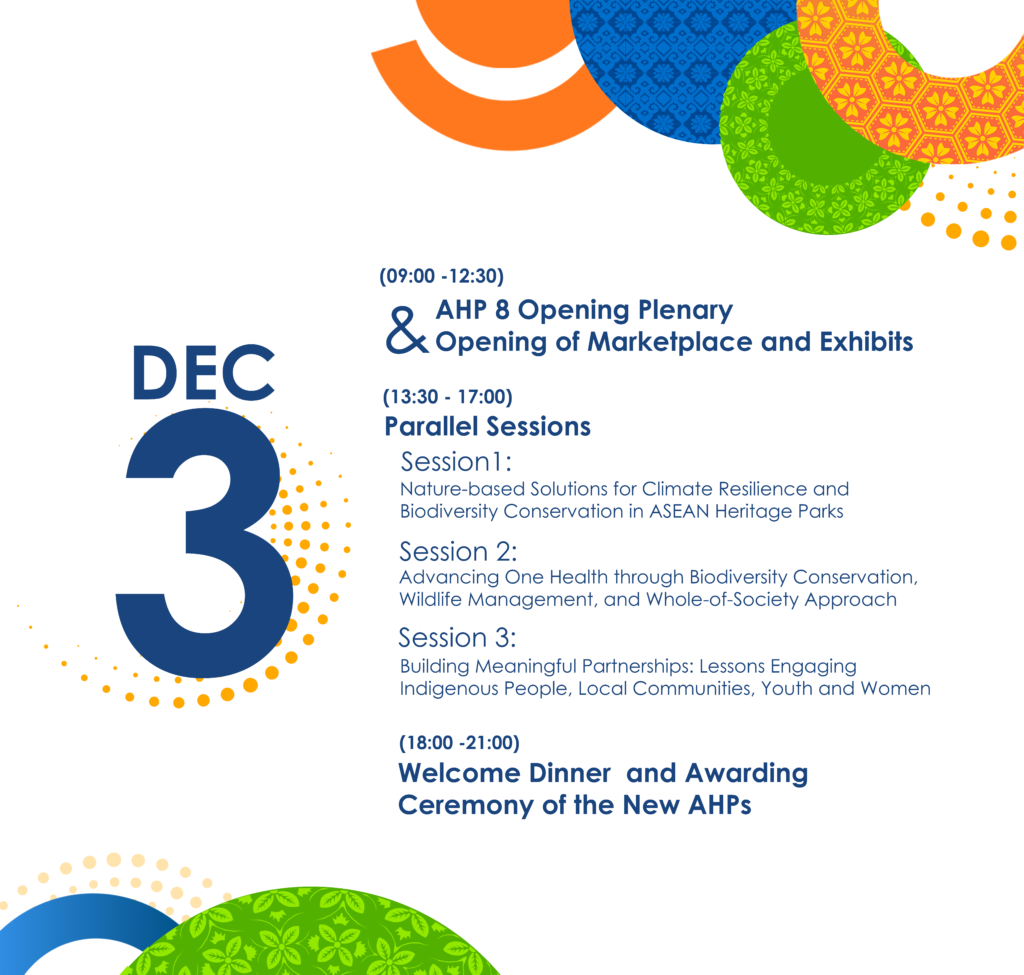
    • Date & Time: 3 December 2025, 9:00 – 12:30
    • Venue: Hồng Quảng (Second floor)
    • Target Participants: All Conference attendees and online participants


      • The Opening Session will highlight the goals and expectations of the Conference. Keynote addresses and presentations on the role of ASEAN Heritage Parks in supporting the implementation of the Kunming-Montreal Global Biodiversity Framework targets, as well as global and regional perspectives and actions on nature-based solutions, climate change adaptation and mitigation, will be highlighted in this session. Additionally, reflections on past AHP Conferences will be shared. 
      • To provide an overview of the Conference, a short pitch will also be delivered by the leads of the parallel sessions to encourage participation from the attendees, as well as a video presentation highlighting the key features of the AHP8 Marketplace and Exhibits. A special ceremony will take place showcasing a series of performances from the host country, Viet Nam.

    Keynote Presentations

    • KM GBF the next five years: Opportunities and Challenges
    • Dr. Uttam Babu Shrestha
    • Global Institute for Interdisciplinary Studies
    • Current trends and status of biodiversity
    • Dr. Joseph Thomas Miller
    • Executive Secretary, Global Biodiversity Information Facility (GBIF)
    • The ASEAN Biodiversity Plan: Opportunities and Challenges for ASEAN towards 2030
    • Ms. Siti Zulaikha binti Abdul Wahab
    • Ministry of Natural Resources and Environmental Sustainability, Malaysia
    • Date & Time: Entire duration of the Conference
    • Venue: Hồng Quảng (Second floor)
    • Target Participants: All Conference attendees


      • The Marketplace and Exhibits will highlight the ASEAN Heritage Parks (AHPs) of the ASEAN Member States, as well as the milestones and key accomplishments of the AHP Programme over the years. It will also provide an opportunity for the AHPs to display their biodiversity-based products and to network with prospective partners. This will also include a pavilion for Viet Nam, as the Conference host country, showcasing the country’s rich biodiversity. 
      • Partners or sponsors who wish to showcase their organisation or products are also encouraged to take part in the Marketplace and Exhibits.
    • Venue: Hồng Quảng (2nd floor)

      As the host country, Viet Nam will warmly welcome all AHP8 participants with a special dinner showcasing its rich culture and hospitality. The evening will feature a short programme prepared by the hosts, offering guests an opportunity to experience local traditions, enjoy authentic Vietnamese cuisine, and foster camaraderie among delegates ahead of the conference sessions. This will also highlight the awarding ceremony for the newly designated AHPs for the previous three years: 

      • 2022
        • 52nd Pasonanca Natural Park (Philippines)
        • 53rd Mt. Inayawan Range Natural Park (Philippines)
        • 54th Bach Ma National Park (Viet Nam)
        • 55th Con Dao National Park (Viet Nam)
      • 2023
        • 56th Phu Khieo Wildlife Sanctuary-Nam Nao National Park (Thailand)
        • 57th Phu Kradueng National Park (Thailand)
      • 2024
        • 58th Phou Xieng Thong National Protected Area (Lao PDR)
        • 59th Balinsasayao Twin Lakes Natural Park (Philippines)
        • 60th Turtle Islands Wildlife Sanctuary (Philippines)
        • 61st Apo Reef Natural Park (Philippines)
        • 62nd Nam Poui National Protected Area (Lao PDR)
        • 63rd Royal Thai Army Nature Education Center (Bang Pu) (Thailand)
      • 2025
        • 64th Tengku Hassanal Wildlife Reserve (Malaysia)
        • 65th Bako National Park (Malaysia)
        • 66th Lambir Hills National Park (Malaysia)
        • 67th Pu Mat National Park (Viet Nam)
        • 68th Dong Nai Culture and Nature Reserve (Viet Nam)
        • 69th Xuan Thuy National Park (Viet Nam)
    • Date & Time: 4 December 2025, 13:00 – 15:00
    • Venue: Yên Đức (Second floor)
    • Target Participants: Focal points involved in ecosystem restoration planning and monitoring, technical specialists, protected area managers, and data practitioners responsible for restoration tracking, geospatial analysis


      • Accessing crucial restoration-related data remains a significant challenge, impeding the scaling of ecosystem restoration efforts. To address this, the Food and Agriculture Organization (FAO), in collaboration with the UN Decade Task Forces on Monitoring and Best Practices, has developed the Framework for Ecosystem Restoration Monitoring (FERM). FERM enhances data access, transparency, and alignment of restoration actions with scientific insights. It also supports countries in monitoring and reporting restoration areas for the Kunming-Montreal Global Biodiversity Framework (KM GBF) Target 2. Launched in 2022, FERM includes a registry of restoration initiatives, a geospatial platform for data visualisation, and a search engine for accessing initiatives and good practices. A data review functionality is being developed to support countries reporting Headline indicator 2.1 Area under restoration to the Convention on Biological Diversity.

      • The FERM Registry allows for the registration of restoration initiatives and good practices, ensuring interoperability with platforms like GEF. The geospatial platform enables analysis of restoration-related data, including remotely sensed data, while the FERM Search engine consolidates initiatives and practices from various collaborating platforms to facilitate knowledge sharing.

      • The ASEAN Heritage Parks initiative brings potential data providers to FERM. Including spatial data of ASEAN Heritage Parks in FERM contributes to the transparent monitoring of ecosystem restoration in the subregion and the effective implementation of Target 2 of the KM GBF.

      • In this workshop side co-organised with the FAO, participants will engage in an interactive overview of FERM, exploring its functionalities and focusing on the importance of registering initiatives and documenting good practices. Through presentations, discussions, and hands-on sessions, the workshop aims to familiarise participants with FERM’s tools and encourage knowledge exchange and capacity building. 

    • Ms. Zhuo Cheng
    • Food and Agriculture Organization (FAO)
    • Date & Time: 4 December 2025, 13:00 – 15:00
    • Venue: Thanh Lân 1 (First floor)
    • Target Participants:  Youth and youth organisations, members of the Indigenous people and local community,  women’s groups, AHP Staff and Managers, Partners, Civil Society Organisations, and other AHP8 Stakeholders 
    • Click here to download the Concept note


      • This side event will bring together youth leaders, government representatives, and ASEAN institutions to strengthen intergenerational collaboration in biodiversity governance. Aligned with the ASEAN Biodiversity Plan (ABP) and the Kunming-Montreal Global Biodiversity Framework, the session will explore innovative practices and pathways to institutionalise meaningful youth participation in biodiversity policy and action. Using a creative participatory activity, Our Collective Story of Kinship with Biodiversity Map, participants will co-create a symbolic representation of shared responsibility across generations, fostering collaboration, inclusivity, and joint commitment toward implementing the ABP and the National Biodiversity Strategy and Action Plans.

    Speakers:

    • Ms. Erista Murpratiwi
    • Bantimurung Bulusaraung National Park, Indonesia
    • Ms. Purnama Yantje
    • Project Manager of Hanns Seidel Stiftung
    • Ms. Somawan Sukprasert
    • Environmentalist, Senior Professional Level
    • Natural Resources and Environmental Policy and Planning, Thailand
    • Mr. Mark Liao Jun
    • President of Sarawak Eco Warriors and 
    • Regional Co-Coordinator of GYBN SEA
    • Date & Time: 4 December 2025, 15:00 – 17:00
    • Venue: Hồng Quảng (Second floor)
    • Target Participants: All Conference attendees


      • The closing session will highlight the objectives achieved by the AHP8. The session will include the presentation of summaries and key recommendations from the breakout sessions. Tokens of appreciation will also be awarded to key partners for their significant contributions to the conference’s success. A short video containing the highlights of the Conference will be played.

    • Date & Time: 4 December 2025, 17:30 – 15:00
    • Venue: Hồng Quảng (Second floor)
    • Target Participants: All Conference attendees


      • The SGP II Closing will be the culminating event bringing together key stakeholders—including implementing partners, technical experts, service providers, park management staff from ASEAN Heritage Parks in Viet Nam, and community beneficiaries. The Closing will highlight the Programme’s successes, best practices, and key lessons learned from activities focused on community awareness, livelihood support, and biodiversity conservation across the four selected SGP-supported AHPs in Viet Nam. As part of the event, discussions will also include the second instalment of ACB’s Project Sustainability Forum, aimed at exploring pathways to ensure that the Programme’s positive outcomes and community-driven initiatives continue to thrive beyond the Programme’s funding cycle.