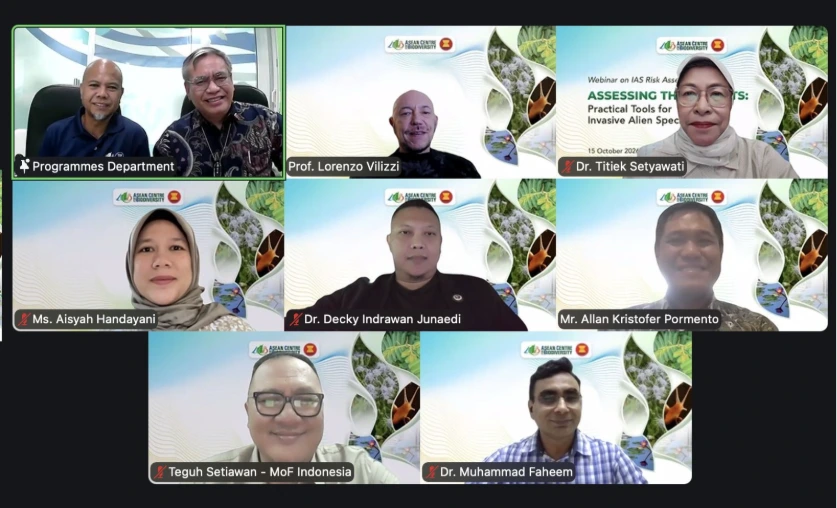
LOS BAÑOS, Laguna—To strengthen the capacities of ASEAN Member States (AMS) in addressing the threat of invasive alien species, the ACB recently organised a webinar titled “Assessing the Threats: Practical Tools for Invasive Alien Species Risks“.
About 400 participants from various biodiversity stakeholder groups and agencies, including those from the agriculture and fisheries sectors, other protected areas, and the ACB’s institutional partners, joined the webinar. This initiative is part of the ACB’s knowledge-sharing and capacity-building efforts as part of its role as one of the technical and scientific cooperation support centres in the implementation of the Kunming-Montreal Global Biodiversity Framework (KM GBF) of the Convention on Biological Diversity.
Invasive alien species (IAS) have been identified as one of the key drivers of biodiversity loss and habitat degradation in Southeast Asia. Globally, it is ranked alongside land- and sea-use change, direct exploitation of species, climate change, and pollution as one of the five primary drivers of biodiversity loss, according to the 2019 Global Assessment Report of the Intergovernmental Science-Policy Platform on Biodiversity and Ecosystem Services (IPBES).
“ASEAN Member States (AMS) have been facing the challenges of IAS despite being biodiversity hotspots,” said ACB Executive Director Dr. Jerome Montemayor in his welcome remarks. “If the invasion of these plants, animals, and microorganisms remains unchecked, it will have irreversible consequences on human well-being and quality of life, other living things, and further deterioration of our planet that is already surviving the effects of climate change,” he added.
Mr. Teguh Setiawan, Deputy Director, Species and Genetic Conservation of the Ministry of Forestry, Indonesia, provided an overview of the IAS management efforts in the ASEAN region and how IAS Risk Assessment Tools could help assess IAS threats and advance conservation efforts. Other prominent IAS experts who delivered presentations in the webinar included Dr. Muhammad Faheem, Integrated Crop Management Advisor, CABI Malaysia; Prof. Lorenzo Vilizzi, Professor of the Department of Ecology and Vertebrate Zoology, Faculty of Biology and Environmental Protection, University of Lodz, Poland; Ms. Aisyah Handayani, Researcher at the Research Centre for Biota Systems – National Research and Innovation Agency (BRIN), Indonesia, and Dr. Decky Indrawan Junaedi, Senior Researcher at BRIN Indonesia.
Four different IAS risk assessment tools were presented by the speakers based on case studies and local experiences. These were the CABI Horizon Scanning Tool used for farm pests, the AS—ISK for aquatic animal species, Weed Risk Assessment applied in terrestrial protected areas, and the Framework and Trait-based Assessment Methods applied in botanical gardens. These tools support the identification, screening, and prioritisation of potentially invasive species.
Regional efforts
Indonesia serves as the lead country for the ASEAN’s IAS management efforts, having spearheaded the development of the ASEAN Action Plan for Invasive Alien Species (IAS) Management, in collaboration with technical support from the ACB, and inputs from other AMS. The said action plan is a roadmap for the ASEAN region in dealing with invasive biological species that threaten native species, causing adverse effects on the region’s already fragile ecosystems as well as the physical and socioeconomic well-being of the human population.
The ASEAN IAS action plan was released in 2024, during the 17th ASEAN Ministerial Meeting on Environment in Laos and the 43rd ASEAN Summit in Indonesia, respectively. This plan includes strengthening legal frameworks and coordination, enhancing public awareness and education, increasing capacity and resources, and conducting risk assessment and prioritisation. This also involves developing risk assessment tools and frameworks and identifying priority species and pathways of introduction.
Another regional instrument supporting IAS management is the ASEAN Heritage Parks Regional Action Plan (AHP RAP). A 10-year strategic roadmap to strengthening the AHP network, the AHP RAP contains the application of science-based and culturally-responsive approaches to the management of natural and socio-cultural resources of the AHPs, including measures to address the challenges of biologically invasive species. It covers the promotion of research-focused conservation of critically endangered and endangered species found within selected AHPs.
In addition, the ASEAN Biodiversity Plan developed by the AMS and the ACB to translate the KMGBF to regional context, has outlined strengthening capacity-building, technology transfer, and scientific and technical cooperation for biodiversity in invasive alien species control and management as part of the strategies in responding to Target 20 of the KMGBF.
Efforts on IAS management support Target 6 of the KMGBF which seeks to eliminate, minimise, reduce, or mitigate impacts of IAS on biodiversity and ecosystem services by 2030. It also supports Targets 2 on ecosystem restoration, 3 on the 30×30 conservation, and Target 5 on sustainable harvest and trade, while Target 20 focuses on strengthening capacity-building and development, access to and transfer of technology, and promoting the development of and access to innovation and technical and scientific cooperation for biodiversity conservation and sustainable use.
A regional workshop held in Jakarta in March 2026 has identified risk assessment in IAS management as one of the priorities for capacity-building initiatives. Standardising tools and methodologies to conduct risk assessments for plants, animals, and fish species were also raised in the said workshop. Hence, this webinar was aimed as a follow-through to the Jakarta workshop.
Strengthened cooperation, regional harmonisation of tools
Towards the end of the webinar, Dr. Titiek Setyawati, IAS and Biodiversity Specialist of the SMIAS Project, Ministry of Forestry and FAO (GEF-7), Indonesia, shared some insights on the current regional actions and ways forward. She noted that scientific screening is the first step in IAS management, enabling early identification of potential risks before reactive management measures. She likewise emphasised that effective IAS prevention and management require an integrated approach combining scientific screening, complementary risk assessment tools, and evidence-based decision-making.
“The real challenge is not the lack of risk assessment tools. It is ensuring that different tools, scientific evidence, and local knowledge are connected to timely and coordinated management action. ASEAN and ACB can play important roles in meeting this challenge,”, Dr. Titiek said.
Ms. Corazon de Jesus, Jr., Acting Director of the ACB’s Programmes Department, closed the programme by sharing that invasive alien species risk assessment works best when done early, based on evidence and adapted to a particular setting to minimise the ecological, economic, and social impacts of biological invasions. She also mentioned the following as ways forward: promotion of complementary risk assessment approaches, strengthening scientific data and technical capacities, enhancing regional cooperation and harmonisation, translating risk assessments into management and policy actions, and alignment with priority actions identified in the ASEAN IAS Action plan and, contributing to the KMGBF targets on species conservation and habitat restoration.