The park offers various ecotourism activities to its guests such as hiking and visiting waterfalls. Visitors may also enjoy the breathtaking views of the sunrise and sunset. The best time to visit the park is from October to May.
Unique Flora
There are 33 species of endemic and rare plants found in the area such as Ya dok lam phong (Photinia stenophylla), Phak Chi Phu Kradueng (Limnophila cephalantha), White rhodedendron (Rhododendron lyi), Indian azalia (Rhododendron simsii), and Proh Phu (Caulokaempferia thailandica)
Unique Fauna
The park is home to critically endangered species such as the Sunda pangolin (Manis javanica) and Elongated tortoise (Indotestudo elongata); and five endangered species, namely, Phayre’s langur (Presbytis phayrei), White-handed gibbon (Hylobates lar), Dhole (Cuon alpinus), Elephant (Elephas maximus), and Big-headed turtle (Platysternon megacephalum)
Habitat Types
mixed deciduous forest, deciduous dipterocarp forest, pine forest, hill evergreen forest and dry evergreen forest
The park offers various ecotourism activities to its guests such as hiking and visiting waterfalls. Visitors may also enjoy the breathtaking views of the sunrise and sunset. The best time to visit the park is from October to May.

The Mt. Timpoong-Hibok-Hibok National Park is composed of two mountains: Mt. Timpoong and Mt. Hibok-Hibok, which is an active volcano located in the northwest area of the island. It is

A terrestrial national park, located within a complex network of forest ecosystems spanning across fourteen (14) protected areas. Legally gazetted since 22 December 1980 and was updated in 1993. The

In the dialect of Southern Thailand, Tarutao means “old, mysterious and primitive”, which describes this island that has been the home for centuries of the Chao Lay, or Sea Gypsies.The
Various efforts from ASEAN Member States and the ACB’s TSCC country parties proactively address this concern through their NBSAP and national commitments to eradicate and reverse degradation. The ASEAN Heritage Parks and the ASEAN Green Initiative exemplify the best practices in ecosystem restoration, enhancing and protecting the integrity of the ecosystems. Ecological restoration and rehabilitation in AHPs demonstrate effective protected area management for the protection and maintenance of the habitat of important species, while the ASEAN Green Initiative showcases the best people-led reforestation initiatives in private lands, urban settings, key biodiversity and various landscapes. These restoration initiatives showcase inclusivity in restoration. The session highlights ASEAN’s best practices in scaling up Target 2 and Target 3 of the KM GBF through its flagship programmes, AHP and the AGI.
While the ASEAN ENMAPS Project contributes to strengthening marine protected area (MPA) networks across Southeast Asia’s Large Marine Ecosystems (LMEs) — the Bay of Bengal, South China Sea, Sulu-Celebes Sea, and the Indonesian Seas, the same ecological connectivity principles apply to terrestrial landscapes, where gene flow, species migration, and habitat corridors ensure biodiversity persistence across fragmented habitats. In line with the GBF Target 3, effective MPA networks in these LMEs must be designed with both ecological science and social legitimacy. The ASEAN Centre for Biodiversity, through the ASEAN ENMAPS, underscores the need to integrate governance studies, perception mapping, and local management experiences with cutting-edge ecological research, such as larval connectivity studies. These connectivity insights reveal how fish and invertebrate larvae disperse across reef systems, highlighting ecological linkages and source–sink dynamics critical for fisheries recovery and biodiversity persistence. Part 1 of this session, therefore, bridges ecological science and stakeholder realities, laying the foundation for network designs that are both scientifically sound and socially legitimate. Building on the outcomes of the Subregional Capacity Building Workshop on Target 3 of the Kunming-Montreal Global Biodiversity Framework for East and Southeast Asia held on 17 to 20 June 2025, which provided an opportunity to discuss key elements of Target 3 of the GBF, Part 2 of this session will revisit key challenges, opportunities, and implementation tools. It will emphasise the recognition of Other Effective Area-based Conservation Measures (OECMs), promoting partnerships and collaboration, and ensuring equity and good governance. This session will also present regional priority actions and strategies to advance ASEAN’s collective progress toward achieving Target 3.
Overall, this session will highlight key actions and collaborations that can contribute and accelerate progress of the ASEAN region towards Target 3.
Various efforts from ASEAN Member States and the ACB’s TSCC country parties proactively address this concern through their NBSAP and national commitments to eradicate and reverse degradation. The ASEAN Heritage Parks and the ASEAN Green Initiative exemplify the best practices in ecosystem restoration, enhancing and protecting the integrity of the ecosystems. Ecological restoration and rehabilitation in AHPs demonstrate effective protected area management for the protection and maintenance of the habitat of important species, while the ASEAN Green Initiative showcases the best people-led reforestation initiatives in private lands, urban settings, key biodiversity and various landscapes. These restoration initiatives showcase inclusivity in restoration. The session highlights ASEAN’s best practices in scaling up Target 2 and Target 3 of the KM GBF through its flagship programmes, AHP and the AGI.
While the ASEAN ENMAPS Project contributes to strengthening marine protected area (MPA) networks across Southeast Asia’s Large Marine Ecosystems (LMEs) — the Bay of Bengal, South China Sea, Sulu-Celebes Sea, and the Indonesian Seas, the same ecological connectivity principles apply to terrestrial landscapes, where gene flow, species migration, and habitat corridors ensure biodiversity persistence across fragmented habitats. In line with the GBF Target 3, effective MPA networks in these LMEs must be designed with both ecological science and social legitimacy. The ASEAN Centre for Biodiversity, through the ASEAN ENMAPS, underscores the need to integrate governance studies, perception mapping, and local management experiences with cutting-edge ecological research, such as larval connectivity studies. These connectivity insights reveal how fish and invertebrate larvae disperse across reef systems, highlighting ecological linkages and source–sink dynamics critical for fisheries recovery and biodiversity persistence. Part 1 of this session, therefore, bridges ecological science and stakeholder realities, laying the foundation for network designs that are both scientifically sound and socially legitimate. Building on the outcomes of the Subregional Capacity Building Workshop on Target 3 of the Kunming-Montreal Global Biodiversity Framework for East and Southeast Asia held on 17 to 20 June 2025, which provided an opportunity to discuss key elements of Target 3 of the GBF, Part 2 of this session will revisit key challenges, opportunities, and implementation tools. It will emphasise the recognition of Other Effective Area-based Conservation Measures (OECMs), promoting partnerships and collaboration, and ensuring equity and good governance. This session will also present regional priority actions and strategies to advance ASEAN’s collective progress toward achieving Target 3.
Overall, this session will highlight key actions and collaborations that can contribute and accelerate progress of the ASEAN region towards Target 3.
Various efforts from ASEAN Member States and the ACB’s TSCC country parties proactively address this concern through their NBSAP and national commitments to eradicate and reverse degradation. The ASEAN Heritage Parks and the ASEAN Green Initiative exemplify the best practices in ecosystem restoration, enhancing and protecting the integrity of the ecosystems. Ecological restoration and rehabilitation in AHPs demonstrate effective protected area management for the protection and maintenance of the habitat of important species, while the ASEAN Green Initiative showcases the best people-led reforestation initiatives in private lands, urban settings, key biodiversity and various landscapes. These restoration initiatives showcase inclusivity in restoration. The session highlights ASEAN’s best practices in scaling up Target 2 and Target 3 of the KM GBF through its flagship programmes, AHP and the AGI.
While the ASEAN ENMAPS Project contributes to strengthening marine protected area (MPA) networks across Southeast Asia’s Large Marine Ecosystems (LMEs) — the Bay of Bengal, South China Sea, Sulu-Celebes Sea, and the Indonesian Seas, the same ecological connectivity principles apply to terrestrial landscapes, where gene flow, species migration, and habitat corridors ensure biodiversity persistence across fragmented habitats. In line with the GBF Target 3, effective MPA networks in these LMEs must be designed with both ecological science and social legitimacy. The ASEAN Centre for Biodiversity, through the ASEAN ENMAPS, underscores the need to integrate governance studies, perception mapping, and local management experiences with cutting-edge ecological research, such as larval connectivity studies. These connectivity insights reveal how fish and invertebrate larvae disperse across reef systems, highlighting ecological linkages and source–sink dynamics critical for fisheries recovery and biodiversity persistence. Part 1 of this session, therefore, bridges ecological science and stakeholder realities, laying the foundation for network designs that are both scientifically sound and socially legitimate. Building on the outcomes of the Subregional Capacity Building Workshop on Target 3 of the Kunming-Montreal Global Biodiversity Framework for East and Southeast Asia held on 17 to 20 June 2025, which provided an opportunity to discuss key elements of Target 3 of the GBF, Part 2 of this session will revisit key challenges, opportunities, and implementation tools. It will emphasise the recognition of Other Effective Area-based Conservation Measures (OECMs), promoting partnerships and collaboration, and ensuring equity and good governance. This session will also present regional priority actions and strategies to advance ASEAN’s collective progress toward achieving Target 3.
Overall, this session will highlight key actions and collaborations that can contribute and accelerate progress of the ASEAN region towards Target 3.
Hosted by Viet Nam, a field trip is scheduled at Ha Long Bay, a UNESCO World Heritage site. It is recognised for its geological and geomorphological value due to the development of karst limestone formations over billions of years. These limestone features are the result of Earth’s tectonic deformation, uplift, erosion, weathering, and sea level changes. Ha Long Bay also represents one of the areas where sea level changes have occurred throughout Earth’s evolutionary history from the Cretaceous period to the present. Thus, Ha Long Bay serves as a living record of global climate change. It also exemplifies the interaction between geological and biological processes, creating a rich and diverse ecosystem
Co-organised with the European Union through the Technical Assistance Facility to the Green Team Europe Initiative (EU-GTEI)
Nature-based Solutions (NbS) are actions to protect, sustainably manage and restore natural and modified ecosystems in ways that address societal challenges effectively and adaptively, to provide both human well-being and biodiversity benefits. This underpins the benefits that flow from healthy ecosystems and targets major challenges like climate change, disaster risk reduction, food and water security, and health are critical to economic development.
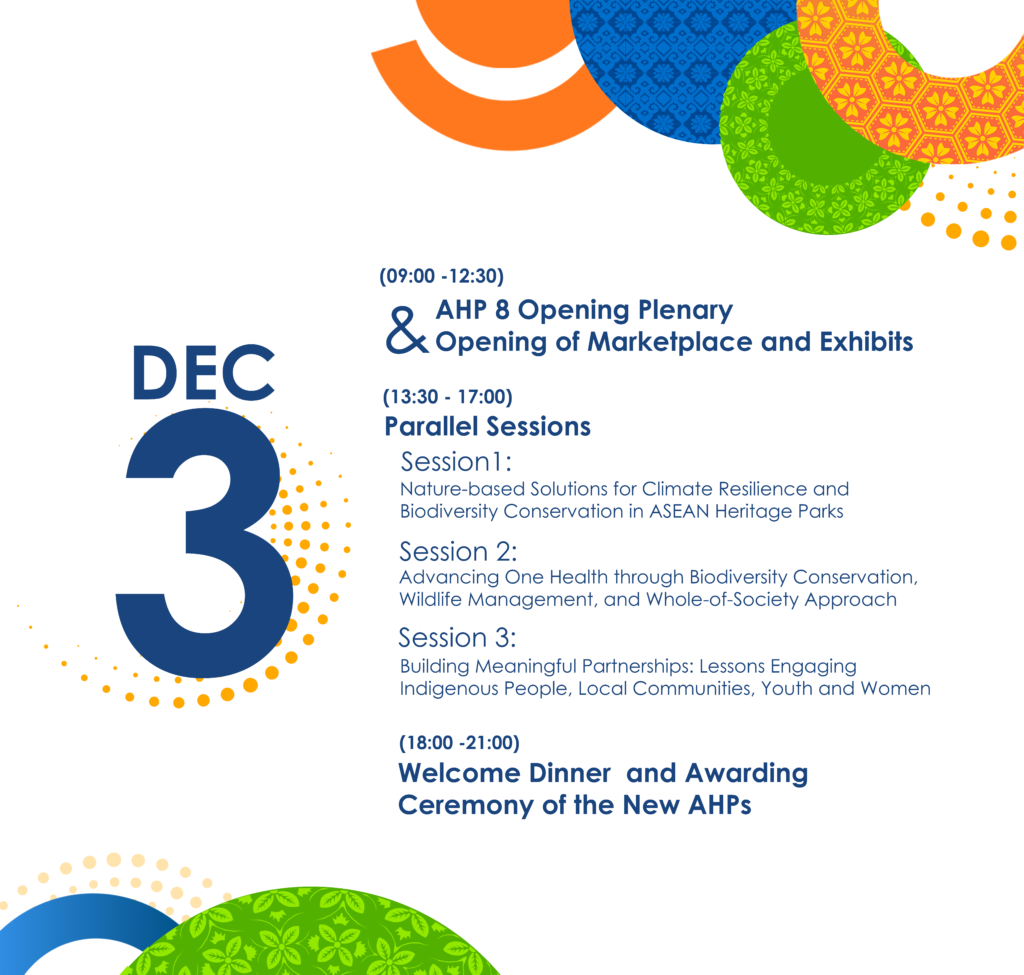
This interactive session will explore how Nature-based Solutions (NbS) can be scaled and adapted across ASEAN Heritage Parks (AHPs) to enhance biodiversity conservation, climate adaptation, and community resilience. Using the ASEAN NbS Platform as a foundation, the sessions will connect landscape-based NbS strategies with the unique ecological and cultural contexts of AHPs.
Mr. Sebastien Goethals
NbS, Spatial & Landscape Planner Expert
Co-designing and Financing NbS Pilot Projects in ASEAN Heritage Parks
Mr. Alvin Lopez
Head of Nature Solutions Finance Hub, ADB (TBC)
Ms. Domiliza Campaner
Park Superintendent
Pasonanca Natural Park, Philippines
Ms. Elisabet Rismauli Wahyuni
Park Manager
Lorentz National Park, Indonesia
Mr. Nguyen Hoang Minh Hai
Head of Scientific Research and International Cooperation Dept
Tram Chim National Park, Viet Nam
co-organised with IMA World Health
AHP 8 – Session 2 – Concept Note
The increasing prevalence of zoonotic disease underscores the need for integrated approaches to managing health risks at the interface of humans, animals, and ecosystems. This urgency was reinforced during the CBD COP 16 with the adoption of the Global Action Plan on Biodiversity and Health. This milestone document promotes preventive, ecosystem-based strategies to address key drivers of zoonotic disease, including habitat loss, illegal wildlife trade, and unsustainable wildlife management. In Southeast Asia, the ACB plays an active role in implementing these principles, having been involved in the development and implementation of the ASEAN One Health Joint Plan of Action (ASEAN OH JPA) following the ASEAN Leaders Declaration on One Health in May 2023. Furthermore, the ACB also fosters regional collaboration and capacity-building initiatives by integrating One Health principles into conservation strategies across ASEAN Member States.
This session will highlight how ASEAN, through the AHP Programme and its wider biodiversity agenda, is contributing to the implementation of the KM GBF. It will also showcase progress on mainstreaming One Health principles into conservation strategies, identify opportunities for cross-sectoral collaboration, and explore innovative pathways for cooperation in line with the goals of the KM GBF and the ASEAN Biodiversity Plan. The session will include the subtopics indicated below and will feature experiences and perspectives from the following speakers and panelists:
Dr. Jerome Montemayor
Executive Director
ASEAN Centre for Biodiversity
Dr. Mardi Caniban
Bureau of Animal Industry
Department of Agriculture
Philippines
Ms. Viny Sutriani
One Health Focal Point
Ministry of Health
Indonesia
Ms. Yang Shufen
Sungei Buloh Wetland Reserve
Singapore
Mr. Oliver Agoncillo
Director
Mainstreaming Biodiversity Division
Programmes Department
ACB
Dr. Melbourne Talactac
Chairman
One Health University Network
Philippines
Ms. Niken Salindri
Program Manager for the
One Health Collaborating Centers
One Health University Network
Indonesia
Ms. Nga Nguyen
One Health Team Leader
Wildlife Conservation Society
Representative Office in Viet Nam
Mr. Elliott James Ong
Co-Founder
Pasarfish
Mr. Muhammad Nur Hisham bin Busra
Park Warden
Endau-Rompin Johor National Park, Malaysia
Ms. Nadia Putri Rachma Persada
Regional Co-Coordinator
Global Youth Biodiversity Network SEA
Dr. Lerma SJ Maldia
Professor, Department of Forest Biological Sciences /
Director, Makiling Center for Mountain Ecosystems
University of the Philippines Los Baños Laguna,
Philippines
Dr. Nguyen Hoang Hao
Director of Dong Nai Nature and Culture Reserve
Deputy Head – Dong Nai World Biosphere Reserve
Management Board
Ms. Sarah Grace Ancheta
M&E Officer
ASEAN Centre for Biodiversity
Mr. Muhammad Abdul Syukur
Director of Penabulu Foundation
Ms. Lina Warlina
AHP Manager representative
Way Kambas National Park
Ms. Ho
Ayun Commune Representative
Ms. Ms. Nguyen Thi Ngoc Lan
Director
Center for Water Resources Conservation and
Development (WARECOD)
Ms. Wai Mon Thet
Range Officer
Nature and Wildlife Conservation Division,
Forest Department
Venue: Hồng Quảng (2nd floor)
As the host country, Viet Nam will warmly welcome all AHP8 participants with a special dinner showcasing its rich culture and hospitality. The evening will feature a short programme prepared by the hosts, offering guests an opportunity to experience local traditions, enjoy authentic Vietnamese cuisine, and foster camaraderie among delegates ahead of the conference sessions. This will also highlight the awarding ceremony for the newly designated AHPs for the previous three years:
Mr. Muhammad Nur Hisham bin Busra
Park Warden
Endau-Rompin Johor National Park, Malaysia
Ms. Nadia Putri Rachma Persada
Regional Co-Coordinator
Global Youth Biodiversity Network SEA
Dr. Lerma SJ Maldia
Professor, Department of Forest Biological Sciences /
Director, Makiling Center for Mountain Ecosystems
University of the Philippines Los Baños Laguna,
Philippines
Dr. Nguyen Hoang Hao
Director of Dong Nai Nature and Culture Reserve
Deputy Head – Dong Nai World Biosphere Reserve
Management Board
Ms. Sarah Grace Ancheta
M&E Officer
ASEAN Centre for Biodiversity
Mr. Muhammad Abdul Syukur
Director of Penabulu Foundation
Ms. Lina Warlina
AHP Manager representative
Way Kambas National Park
Ms. Ho
Ayun Commune Representative
Ms. Ms. Nguyen Thi Ngoc Lan
Director
Center for Water Resources Conservation and
Development (WARECOD)
Ms. Wai Mon Thet
Range Officer
Nature and Wildlife Conservation Division,
Forest Department
Various efforts from ASEAN Member States and the ACB’s TSCC country parties proactively address this concern through their NBSAP and national commitments to eradicate and reverse degradation. The ASEAN Heritage Parks and the ASEAN Green Initiative exemplify the best practices in ecosystem restoration, enhancing and protecting the integrity of the ecosystems. Ecological restoration and rehabilitation in AHPs demonstrate effective protected area management for the protection and maintenance of the habitat of important species, while the ASEAN Green Initiative showcases the best people-led reforestation initiatives in private lands, urban settings, key biodiversity and various landscapes. These restoration initiatives showcase inclusivity in restoration. The session highlights ASEAN’s best practices in scaling up Target 2 and Target 3 of the KM GBF through its flagship programmes, AHP and the AGI.
While the ASEAN ENMAPS Project contributes to strengthening marine protected area (MPA) networks across Southeast Asia’s Large Marine Ecosystems (LMEs) — the Bay of Bengal, South China Sea, Sulu-Celebes Sea, and the Indonesian Seas, the same ecological connectivity principles apply to terrestrial landscapes, where gene flow, species migration, and habitat corridors ensure biodiversity persistence across fragmented habitats. In line with the GBF Target 3, effective MPA networks in these LMEs must be designed with both ecological science and social legitimacy. The ASEAN Centre for Biodiversity, through the ASEAN ENMAPS, underscores the need to integrate governance studies, perception mapping, and local management experiences with cutting-edge ecological research, such as larval connectivity studies. These connectivity insights reveal how fish and invertebrate larvae disperse across reef systems, highlighting ecological linkages and source–sink dynamics critical for fisheries recovery and biodiversity persistence. Part 1 of this session, therefore, bridges ecological science and stakeholder realities, laying the foundation for network designs that are both scientifically sound and socially legitimate. Building on the outcomes of the Subregional Capacity Building Workshop on Target 3 of the Kunming-Montreal Global Biodiversity Framework for East and Southeast Asia held on 17 to 20 June 2025, which provided an opportunity to discuss key elements of Target 3 of the GBF, Part 2 of this session will revisit key challenges, opportunities, and implementation tools. It will emphasise the recognition of Other Effective Area-based Conservation Measures (OECMs), promoting partnerships and collaboration, and ensuring equity and good governance. This session will also present regional priority actions and strategies to advance ASEAN’s collective progress toward achieving Target 3.
Overall, this session will highlight key actions and collaborations that can contribute and accelerate progress of the ASEAN region towards Target 3.
Accessing crucial restoration-related data remains a significant challenge, impeding the scaling of ecosystem restoration efforts. To address this, the Food and Agriculture Organization (FAO), in collaboration with the UN Decade Task Forces on Monitoring and Best Practices, has developed the Framework for Ecosystem Restoration Monitoring (FERM). FERM enhances data access, transparency, and alignment of restoration actions with scientific insights. It also supports countries in monitoring and reporting restoration areas for the Kunming-Montreal Global Biodiversity Framework (KM GBF) Target 2. Launched in 2022, FERM includes a registry of restoration initiatives, a geospatial platform for data visualisation, and a search engine for accessing initiatives and good practices. A data review functionality is being developed to support countries reporting Headline indicator 2.1 Area under restoration to the Convention on Biological Diversity.
The FERM Registry allows for the registration of restoration initiatives and good practices, ensuring interoperability with platforms like GEF. The geospatial platform enables analysis of restoration-related data, including remotely sensed data, while the FERM Search engine consolidates initiatives and practices from various collaborating platforms to facilitate knowledge sharing.
The ASEAN Heritage Parks initiative brings potential data providers to FERM. Including spatial data of ASEAN Heritage Parks in FERM contributes to the transparent monitoring of ecosystem restoration in the subregion and the effective implementation of Target 2 of the KM GBF.
In this workshop side co-organised with the FAO, participants will engage in an interactive overview of FERM, exploring its functionalities and focusing on the importance of registering initiatives and documenting good practices. Through presentations, discussions, and hands-on sessions, the workshop aims to familiarise participants with FERM’s tools and encourage knowledge exchange and capacity building.
The Closing Plenary Session will highlight the objectives achieved by the Eighth ASEAN Heritage Parks Conference and will include the presentation of summaries and key recommendations from the breakout sessions. Tokens of appreciation will also be awarded to key partners for their significant contributions to the Conference’s success. A short video containing the highlights of the Conference will be presented.
The SGP II Closing will be the culminating event bringing together key stakeholders—including implementing partners, technical experts, service providers, park management staff from ASEAN Heritage Parks in Viet Nam, and community beneficiaries. The Closing will highlight the Programme’s successes, best practices, and key lessons learned from activities focused on community awareness, livelihood support, and biodiversity conservation across the four selected SGP-supported AHPs in Viet Nam. As part of the event, discussions will also include the second instalment of ACB’s Project Sustainability Forum, aimed at exploring pathways to ensure that the Programme’s positive outcomes and community-driven initiatives continue to thrive beyond the Programme’s funding cycle.