Dr. Jerome L. Montemayor
Executive Director, ASEAN Centre for Biodiversity (ACB)
This year marks a crucial midpoint. Four years have passed since the launch of the Kunming-Montreal Global Biodiversity Framework (KM GBF) in 2022, and we have four more years left to achieve this ambitious roadmap of 23 targets by 2030.
Our celebration of International Day for Biological Diversity (IDB) offers an opportune moment for us across the ASEAN region and beyond to celebrate what we have done to contribute to these goals and to renew our shared commitment to biodiversity conservation and sustainable use.
As part of our region’s commitment, the ASEAN Biodiversity Plan (ABP) was developed and launched at the 2024 UN Biodiversity Conference in Cali, Colombia. This regional plan guarantees complementarity with the KM GBF, the ASEAN Community Vision 2045, and with the National Biodiversity Strategies and Action Plans of ASEAN Member States (AMS). While these large-scale regional and national plans, strategies, and activities are fundamental, these would not be complete without local actions. This year’s theme for the IDB, “Acting Locally for Global Impact”, highlights the important reality that local, on-the-ground initiatives run by individuals, local communities, and key stakeholder groups are a crucial part in achieving global biodiversity targets.
The ASEAN Centre for Biodiversity (ACB), the region’s centre of excellence for biodiversity and one of the technical and scientific cooperation support centres chosen by the Convention for Biological Diversity for the implementation of the KM GBF, has always valued local action in its programmes and flagship initiatives.
Local action is also at the heart of the Small Grants Programme by the ACB (SGP), the longest-running programme of the ACB. Since 2014, the SGP has played a vital role in protecting biodiversity, supporting natural resource management, and improving the livelihoods of local communities in and around select ASEAN Heritage Parks (AHPs) across Indonesia, Myanmar, and Viet Nam.
In Myanmar, the SGP mobilised local actions among 12 buffer zone communities in the Meinmahla Kyun Wildlife Sanctuary (MKWS) to conserve the vast mangrove ecosystem. Led by one of the SGP’s partners, the Myanmar Environmental Rehabilitation-Conservation Network, the project established a revolving fund that supported community-based agroforestry and livelihood initiatives and led to the establishment of nurseries for mangrove restoration. It created job opportunities, and at the end of the project, more than 720 hectares of mangrove areas were restored using a native mangrove tree species locally called Laba (Sonneratia griffithii). Another notable initiative related to the SGP was implemented in Way Kambas National Park, Indonesia, which has long been known for tourism centred on the endemic Sumatran elephant (Elephas maximus ssp. sumatranus). Together with community members, the Kelompok Sadar Wisata, or POKDARWIS, developed ecotourism packages that helped shift traditional mass tourism to a more community-driven model. As communities became more involved, they also developed a stronger appreciation for elephant welfare, viewing the animals not as threats but as partners in local development. You can find other community stories from the SGP in this special edition of the ASEAN Biodiversity Magazine.
Last month, during ASEAN Climate Week, we marked a new phase for the SGP. In partnership with KfW Development Bank and the European Union, SGP III will expand its reach to Cambodia, Lao PDR, the Philippines, and Viet Nam—strengthening biodiversity conservation and building community resilience. At the regional level, this phase also contributes to the KM GBF Targets 3, 8, 9, 10, and 14.
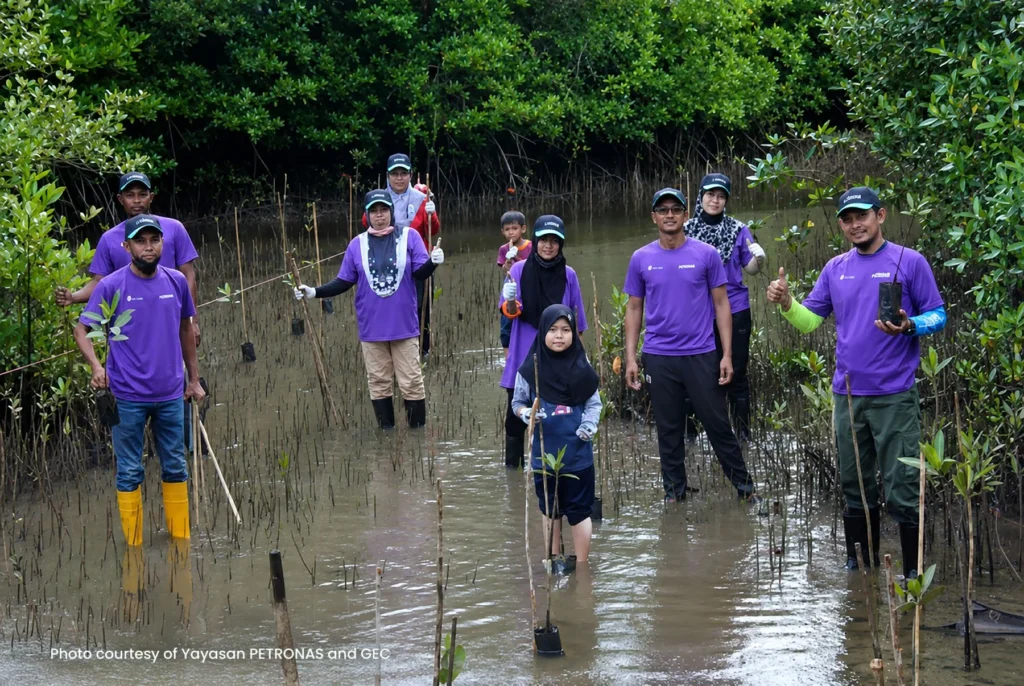
This year, we are also accepting nominations for the second staging of the ASEAN Green Initiative (AGI), which aims to plant 10 million trees in 10 years across the AMS while improving people’s well-being, livelihoods, and resilience. This local action-based programme aims to encourage and recognise exemplary ecosystem restoration activities by government agencies, organisations, the private sector, and individuals.
Community action is also an important component of the Effectively Managing Networks of Marine Protected Areas in Large Marine Ecosystems in the ASEAN Region (ASEAN ENMAPS) Project. Implemented by the ACB and the UNDP in Asia and the Pacific through the funding of the Global Environment Facility, this regional initiative works with local communities in Indonesia, the Philippines, and Thailand to enhance the management of networks of marine protected areas and marine corridors within selected large marine ecosystems.
To harness local action for conservation, the ASEAN ENMAPS project will support various initiatives that advance marine conservation through community-based management, sustainable fisheries, and the protection and restoration of critical coastal and marine ecosystems. One promising example is the “buka tutup gurita”, or the octopus seasonal closure system. Introduced in 2014, this community-led approach regulates octopus harvesting during peak months from June to August. This does not only promote sustainable fisheries management and marine resource recovery. More importantly, such locally driven efforts highlight the value of community stewardship and collaborative action in ensuring the long-term health and resilience of marine ecosystems in Indonesia.
Responding to the pressing environmental crisis of peatlands and wetlands, which used to be natural carbon sponges but are now turning into major sources of carbon emissions, the ACB is currently implementing the Enhancing Conservation and Restoration of Wetlands and Peatlands in ASEAN as Effective Sinks and Reservoirs of Greenhouse Gases (EnCORE Wetlands) Project. Funded by the UK Mission to ASEAN through the ASEAN-UK Green Transition Fund, the EnCORE Wetlands Project works with Indigenous Peoples and local communities surrounding the Agusan Marsh Wildlife Sanctuary in the Philippines and the Maludam National Park in Malaysia. The project aims to equip local key stakeholders with knowledge and skills to implement effective conservation and restoration measures and to create science-based and practical methods to protect these carbon-rich ecosystems that can be scaled up for use throughout the AMS.
The ACB also contributes to enabling local action through different capacity-building activities related to its initiatives, such as the AHP Programme, our network of 69 protected areas of high conservation importance that protect a wide array of ecosystems in the ASEAN region; the ASEAN Flyway Network; and the ASEAN Youth Biodiversity Programme (AYBP), which aims to ensure that youth aged 15–35 are recognised and actively involved in biodiversity policies and actions across ASEAN.
Mainstreaming biodiversity, the ACB’s response to Targets 14 and 22 of the KM GBF and the goals of the ABP, is an active effort by the ACB to realise transformative change in the way biodiversity conservation is embedded in every aspect of ASEAN’s governance, economy, and society. This initiative does not only embed nature’s values into policies, planning, and development, it also advances conservation alongside livelihoods, health, and sustainable green growth. The ACB strives to turn these commitments into action through guidelines, toolkits, and programmes and by breaking sectoral silos and partnering with the private sector through initiatives like the ASEAN Business and Biodiversity Initiative to unlock finance and solutions, engaging businesses, communities, governments, and individuals, and ensuring mainstreaming is both strategic for nature and people in the ASEAN and beyond.
While these initiatives ensure inclusive participation of Indigenous Peoples, local communities, women, youth, the private sector, and other key stakeholder groups, it is equally important for families, small groups, and even individuals to step up and contribute to achieving our goals. This is reflected in our #WeAreASEANBiodiversity Campaign. Every ASEAN citizen can and should play a role in biodiversity conservation. No action is too small to count and catalyse a global impact that contributes to our shared mission.
At the personal level, one can start taking interest in nature and biodiversity by joining hiking trips, visiting one of our AHPs, forest bathing, attending birdwatching sessions, and supporting responsible and sustainable ecotourism. This should inspire us to adopt a conscious change in lifestyle by shifting to more sustainable habits such as responsible consumption, more mindful use of resources, properly reducing and segregating waste, refusing single-use plastics, and supporting sustainably sourced products and local businesses. In a more active role, one can be part of local ecosystem restoration efforts, such as tree planting and growing activities using the right species in the appropriate areas; volunteering in programmes of the AHPs near you; clean-up drives; and not patronising illegal wildlife trade, among many others. Even the simple act of sharing biodiversity information on social media counts as a means of increasing awareness of the importance of biodiversity conservation! While these may seem like small actions, each one contributes to the solution.
The ACB remains committed to supporting these efforts by facilitating regional cooperation, providing technical assistance, and connecting regional initiatives with local stakeholders to amplify its impact. At this midpoint, we continue to call upon governments, the academe, businesses and the private sector, civil society organisations, communities, and even individuals to work with us and work together in accelerating local action as we approach our 2030 targets.
Let us make every action count in our shared dream of living in harmony with nature.
Happy International Day for Biodiversity!