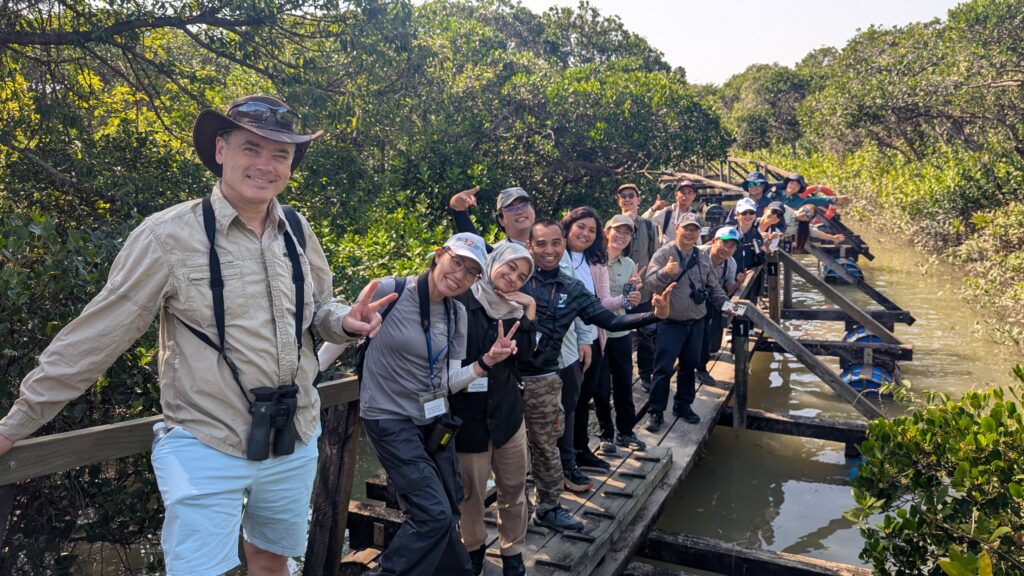
Over 25 site managers and government officials from the ASEAN Flyway Network (AFN) convened at Mai Po Nature Reserve, Hong Kong SAR, for two regional training workshops aimed at strengthening wetland management and migratory waterbird conservation along the East Asian–Australasian Flyway.
Co-organised by WWF-Hong Kong and the AFN, with support from the ASEAN Centre for Biodiversity (ACB) and the Sungei Buloh Wetland Reserve of the National Parks Board, Singapore, as the current chair of the AFN, and generously supported by the Asia-Pacific Network for Global Change Research (APN), the workshops form part of the project “Empowering Site Managers for Effective Wetland and Migratory Waterbird Conservation in Asia.” The workshops aimed to equip participants with science-based management skills, nature-based solutions, communication, education, participation, and awareness (CEPA), and emerging technologies like the Internet of Things (IoT) to promote adaptive site-based responses to climate and biodiversity challenges affecting wetlands across Southeast Asia.
The January workshop focused on AFN Site Managers, emphasising practical wetland management, adaptive planning, community engagement, and biodiversity monitoring. Through field visits and technical sessions at Mai Po Nature Reserve, a Wetland of International Importance and recipient of the Wetland Link International Gold Star Award for best practice, participants examined habitat management with the integration of traditional knowledge and technology that support wildlife conservation.
The March workshop brought together AFN National Focal Points and representatives to strengthen regional coordination and align site-level management practices with national frameworks and international environmental commitments.
Organised in conjunction with the workshop, the 4th AFN meeting was convened, where participants embarked on the inception of the AFN-Strategic Action Plan, charting the new way forward to enhance communications and collaboration among site managers and government representatives, reinforcing ASEAN’s collective flyway commitments.
“Wetlands and migratory bird conservation is central to the work of the ACB and with the ASEAN Member States. This training workshop intended to build the capacities of AFN site managers and national focal points is very relevant and timely, as the ASEAN region lies at the heart of the East Asian-Australasian Flyway,” shared ACB Biodiversity Conservation Division Director, Amiel Sarne. “It provided participants with hands-on experience in addressing various issues in wetland and migratory bird management at AFN sites and Mai Po Nature Reserve. The ACB thanks WWF-Hong Kong for this collaboration, and we look forward to more as we boost the protection of around 50 million waterbirds that visit our flyway every year and the habitats they depend on,” he added.
“We are excited to partner with leading organisations to enhance flyway conservation. Using Mai Po Nature Reserve as a living classroom, we share our successes and lessons learned from over 40 years of wetland management experience in collaboration with different stakeholders. As part of the flyway, we strive to connect sites, strengthen partnerships, and contribute to a more cohesive and resilient flyway network.” Vivian Fu, Wetlands for Asian Flyways Initiative Lead, WWF Hong Kong, noted.
The workshops were delivered in collaboration with the University of Hong Kong, as well as partners of the East Asian–Australasian Flyway Partnership (EAAFP), including the Ramsar Regional Centre – East Asia (RRC-EA) and the Paulson Institute. It is the first time WWF-Hong Kong has co-organised a special training on nature-based solutions with the International Union for Conservation of Nature (IUCN).
“Wetlands are not connected by themselves. Migratory birds connect them. And people keep that connection strong through care and good management. When a shorebird leaves Mai Po and later arrives in Sibugay, Korea, or Cambodia, it creates a living bridge between those wetlands. And when you sit together this week, you become the human bridge that protects that living bridge.” Jennifer George, Chief Executive of the EAAFP, said.
“IUCN is pleased to support these critical trainings for site managers and decision-makers. There is huge potential for nature-based solutions in wetlands to provide benefits for both people and biodiversity; however, they are vastly underutilised. Through this hands-on training, individuals responsible for wetland conservation can see firsthand the potential of wetlands to help solve the problems that societies are facing, while also providing habitat for migratory birds.” Katie Bimson, Senior Programme Officer for Water and Wetlands Nature-based Solutions of the IUCN Asia Regional Office, mentioned.
“Wetland conservation and its wise use are at the heart of the RRC-EA. This workshop is vital for strengthening the AFN and building the capacity of site managers to protect migratory waterbirds,” stated RRC-EA Executive Director Suh Seung-oh. “By equipping site managers with practical management tools, we are securing the future of the East Asian-Australasian Flyway. The RRC-EA remains committed to these regional partnerships to safeguard our shared wetland heritage and the millions of birds that depend on it.”
“Migratory waterbirds inspire us with their incredible pan-hemispheric journeys of endurance, travelling from as far north as Arctic Siberia to as far south as Australia and New Zealand. They also represent a shared natural heritage among all the countries they grace. With that comes a shared responsibility to protect them and the places they need. Collaboration and sharing of best practice – as facilitated by WWF HK and the AFN – is the fundamental foundation for safeguarding this inheritance,” Terry Townshend, Fellow of the Paulson Institute, said.
“Effective management of wetlands in the region is challenging given the mounting threats of habitat loss, climate change, and other pressures to these valuable ecosystems. Mai Po serves as a wonderful example of what is possible – these workshops have facilitated essential collaboration ties across the flyway to propagate the success we’ve seen in Hong Kong” Prof. Tim Bonebrake, Director and Professor at the School of Biological Sciences, University of Hong Kong, added.
To sustain momentum, two regional webinars will be held in 2026: one in May aligned with World Migratory Bird Day, and another in July marking World Mangrove Day. These sessions will invite trained participants to share their experiences in site management, which will allow the community to expand outreach, promote continued knowledge exchange, and reinforce site and national commitment to conserving wetlands critical to migratory waterbirds.
Wetlands across Asia face rapid development, habitat loss, and climate-induced impacts such as sea-level rise and extreme weather. Recognising the ecological connectivity of wetlands through migratory birds, the project aims to strengthen the networks of wetland managers and decision-making officials, to foster knowledge exchange and promote regional cooperation, which would collectively enhance the protection of critical wetland habitats on the flyway.
Media Contacts:
WWF-Hong Kong
Ms. Vivian Fu, Wetlands for Asian Flyways Initiative (vivianfu@wwf.org.hk)
Mr. Christopher Wong, Communications, WWF-Hong Kong (christopherwong@wwf.org.hk)
ASEAN Centre for Biodiversity and ASEAN Flyway Network
Mr. Jerome Cayton C. Barradas, Public Engagement (jcbarradas@aseanbiodiversity.org)
Ms. Pamela Q. Reblora, Communication, (pqreblora@aseanbiodiversity.org)
East Asian–Australasian Flyway Partnership (EAAFP)
Ms. Minjae Baek (communication@eaaflyway.net)