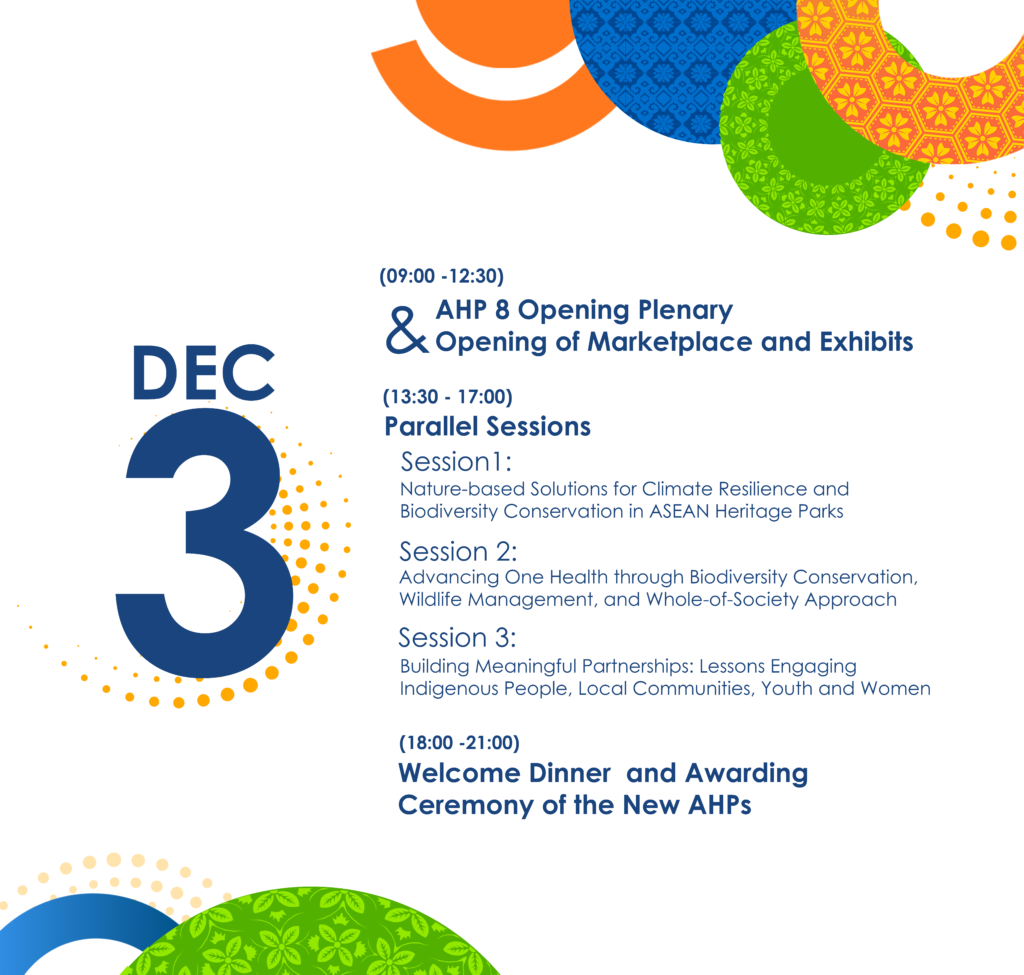
The ASEAN Heritage Parks markers for Apo Reef Natural Park in Occidental Mindoro (left) and Balinsasayao Twin Lakes Natural Park (right) in Negros Oriental.
Celebrating their addition to the distinguished network of protected areas with high conservation importance in the ASEAN region, the Philippines’ Apo Reef Natural Park (ARNP) and Balinsansayao Twin Lakes Natural Park (BTLNP), have recently unveiled their markers as the 61st and the 59th ASEAN Heritage Parks (AHP).
Apo Reef’s anniversary
In line with its 29th anniversary on 6 September 2025, the ARNP conducted a public ceremony to celebrate three conservation milestones, namely, the unveiling of the AHP marker, the blessing of its new Protected Area Management Office (PAMO) building, and recognition of the ARNP’s major conservation partners and champions.
The 61st AHP, known as the “crown jewel” of Occidental Mindoro province, stretches 27,488 hectares in the MIMAROPA region of Southern Luzon, Philippines. It is also an International Bird Area (IBA) and holds the distinguished Blue Park Award for its outstanding conservation of marine wildlife. Apo Reef is the largest atoll-like reef in the Philippines and the second largest contiguous reef system in the world, spanning vibrant coral reefs, pristine lagoons, seagrass beds, various mangroves, and lush beach forests. It is a sanctuary for over 482 fish species, 63 genera of hard corals, rare marine invertebrates such as the Endangered Green Sea Turtle (Chelonia mydas) and Critically Endangered Hawksbill Turtle (Eretmochelys imbricata), and iconic species like Dugongs (Dugong dugon), Whale Sharks (Rhincodon typus), and Hammerhead Sharks (Genus Sphyrna).
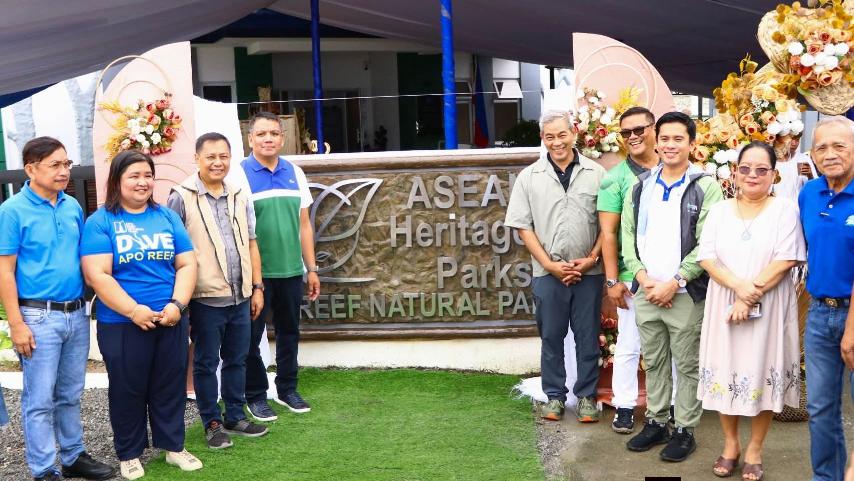
Stakeholders and conservation partners who have been vital to the ARNP’s protection were honoured during the anniversary celebration and AHP marker unveiling ceremony. Photo by: DENR MIMAROPA
The newly built Apo Reef Protected Area Management Office (PAMO) building is envisioned as a hub for conservation management, enforcement, education, and collaboration. According to ARNP officials, the building symbolises strengthened stewardship and governance for the reef’s protection.
Representing the ACB, Dr. Arvin Diesmos, Senior Director of the Biodiversity Knowledge Management Department, lauded the exceptional management of the Park and the strong collaboration among its stakeholders. He cited that the AHP marker is a symbolic recognition of the tireless work of all stakeholders who persevered to conserve and restore Apo Reef to being one of the best natural parks in the ASEAN region.
‘The ACB, as the Secretariat of the AHP Programme, is always ready to assist and support the ARNP management in its efforts to further enhance its operations. We will continue to further amplify your work and promote the ecological and cultural significance of ARNP through communication, education, and public awareness. We will keep close collaboration within the AHP Network to ensure that our efforts are in line with the ASEAN Biodiversity Plan and the Kunming-Montreal Global Biodiversity Framework (KM GBF),’ added Dr. Diesmos.
Negros’ Twin Lakes: first AHP in the Visayas
The famous twin lakes in the municipality of Sibulan, Negros Oriental, officially called the Balinsasayao Twin Lakes Natural Park (BTLNP), have been named the 59th AHP. It is the 13th AHP in the Philippines and the first in the Visayas region. To commemorate its declaration as an AHP, a ceremony gathering all stakeholders was held on 21 November by the local PAMO.
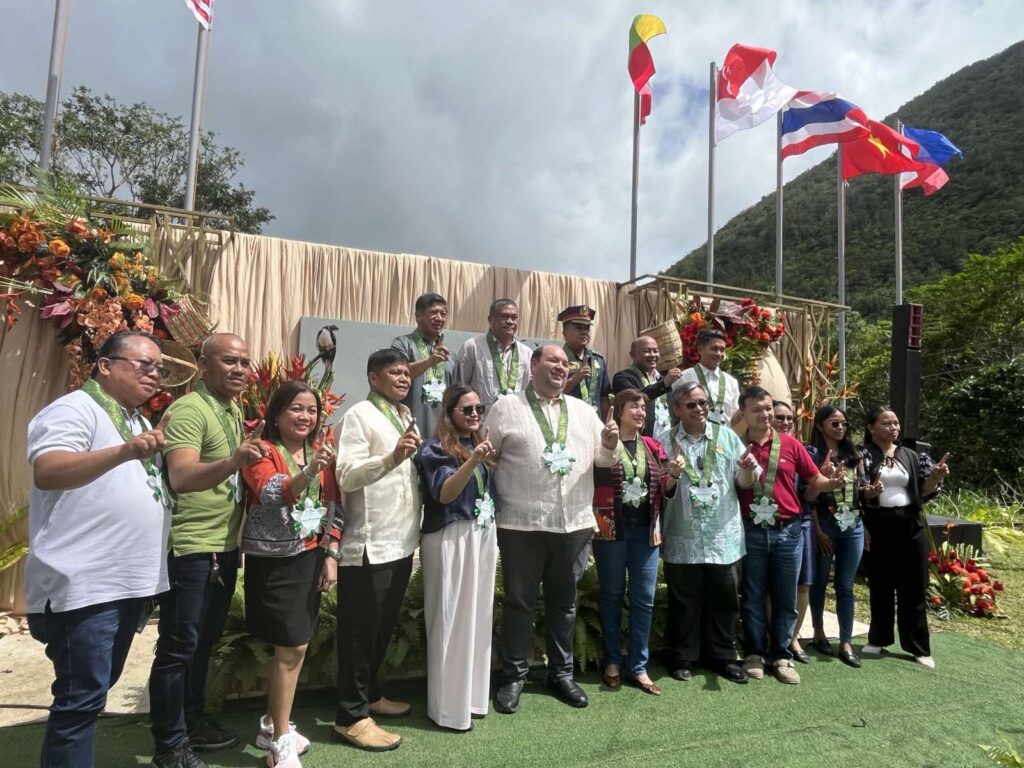
The effective park management of BTLNP is attributed to the active cooperation of the government, partners, and the community, who helped elevate its status as an internationally significant protected area.
The unveiling of the marker coincided with the anniversary of the twin lakes’ declaration as a “protected area” by virtue of Presidential Proclamation No. 414 of former president Joseph Estrada. Among the highlights of the ceremony was the turnover of the AHP Certificate from the ASEAN Centre for Biodiversity (ACB) and the DENR Biodiversity Management Bureau (DENR-BMB) to the PAMO – BTLNP and the Protected Area Management Board (PAMB) of the twin lakes.
Negros Oriental Gov. Manuel “Chaco” Sagarbarria and Negros Oriental 2nd District Representative Maisa Sagarbarria graced the occasion, which was attended by local government unit officials from Sibulan and San Jose, and officers and members of Balinsasayao Twin Lakes Farmers’ Association, as well as the People’s Organization operating and managing eco-tourism activities in the twin lakes.
Among the visitors were ACB Executive Director Dr. Jerome Montemayor, representatives from the PAMO – BTLNP, the DENR though the National Parks Division of the Biodiversity Management Bureau, Negros Island Regional Office and Negros Oriental Provincial Office, and Community Environment and Natural Resources Office-Dumaguete ; and the PAMB.
Covering an area of 8,016.05 hectares, BTLNP is home to a total of 325 of fern species, 237 tree species, 27 mammalian fauna, 209 resident and migrant birds, of which 14 species are globally threatened. Among the globally important species present in the Park are the Endangered Negros Shrew (Crocidura negrina), Visayan Spotted Deer (Rusa alfredi), Visayan Leopard Cat (Prionailurus bengalensis rabori), the Critically Endangered Philippine Tube-nosed Fruit Bat (Nyctimene rabori) and the Visayan Warty Pig (Sus cebifrons negrinus), as well as Philippine endemic species like the Endangered Golden-crowned Flying Fox (Acerodon jubatus). BTLNP is also a habitat of some globally threatened bird species most notably, the Critically Endangered Negros Bleeding-heart Pigeon (Gallicolumba keayi) and the Visayan Wrinkled-billed Hornbill (Aceros waldeni).
“At the upcoming ASEAN Heritage Parks Conference in Quang Ninh, Viet Nam this December, I am optimistic that wetland AHPs will receive increased attention and conservation efforts as we intensify regional initiatives to meet Targets 2 and 3 of the Kunming-Montreal Global Biodiversity Framework”, said Dr. Montemayor in his speech.
The inclusion of both the ARNP and the BTLNP as AHPs was approved by the ASEAN Ministerial Meeting on the Environment on 19 September 2024.