ACB Executive Director Dr. Jerome L. Montemayor handed over the ASEAN Heritage Park certificate to General Ekarat Changkaew, Chairman of the Advisory Board of the Royal Thai Army, on the inclusion of the Bang Pu Nature Education Center in the AHP network.
SAMUT PRAKAN, Thailand – A grand event was held by the Royal Thai Army for the inauguration and unveiling of the ASEAN Heritage Park (AHP) marker of the Bang Pu Nature Education Center on 15 August 2025.
The event was attended by ACB Executive Director Dr. Jerome Montemayor and officials from the Office of Natural Resources and Environmental Policy and Planning (ONEP) Thailand, the Department of Water Resources, and the Provincial Administrative Organisation of Samut Prakan. It included the Royal Salute and Blessing Ceremony, an almsgiving ceremony, the ceremonial release of one million tiger prawns and 30,000 sea bass on Sukta Bridge, and the reading of the royal tribute statement. It was also an opportunity to conduct the awarding ceremony of the second wall painting competition with the theme “Sustaining the Legacy of Bangpu Mangrove Forest Conservation and Passing it on Sustainably”, which was participated in by different schools from all over Thailand.
The unveiling of the AHP signage served as the culminating activity where Dr. Montemayor himself awarded the AHP certificate to the Bang Pu management.
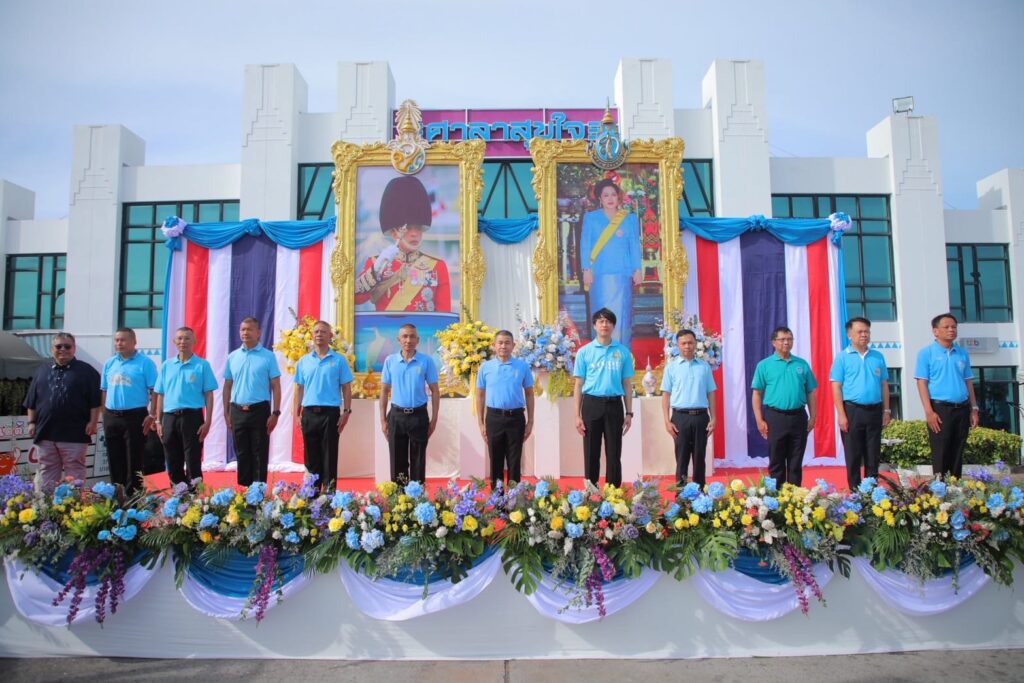
Dr. Montemayor joined the officials of the Royal Thai Army in giving honours to the King and Queen in Thailand as part of the ceremonies for the AHP marker unveiling of Bang Pu. Photo by: Royal Thai Army
An urban wetland
Bang Pu is the 63rd AHP conferred by the ASEAN Environment Ministers via ad referendum on 6 December 2024 in honour of His Majesty King Maha Vajiralongkorn Phra Vajiraklaochaoyuhua’s (Rama X) 72nd birthday. A seaside resort on the Bay of Bangkok, Bang Pu literally means a ‘’place of crabs’’ and is now known as one of the most beautiful birdwatching and sunset viewpoints in Thailand.
Bang Pu is classified as an urban wetland with diverse ecosystems such as mangrove forests, vast mudflats, and remarkable biodiversity, having over 560 species of fauna and 22 species of flora. There are over 5,000 migratory seagulls observed visiting the site every year from November to January to escape the cold winter in Russia.
Bang Pu is currently being maintained by the Quartermaster Department of the Royal Thai Army. The Center was originally established in 1937 as a recuperation site for soldiers injured in combat, until the Royal Thai Army, in collaboration with the World Wide Fund for Nature (WWF) Thailand, transformed Bang Pu into a centre for biodiversity conservation and a study area for the youth, government, agencies, and the private sector.
The Centre is a vital refuge for several globally endangered species. Notably, it is home to the Irrawaddy Dolphin (Orcaella brevirostris) and various endangered migratory shorebirds, including the Black-faced Spoonbill (Platalea minor), Nordmann’s Greenshank (Tringa guttifer), Great Knot (Calidris tenuirostris), and Far Eastern Curlew (Numenius madagascariensis).
The area supports internationally significant species such as the Brown-headed Gull (Chroicocephalus brunnicephalus) and Black-tailed Godwit (Limosa limosa), underscoring its importance as a critical habitat for these vulnerable populations.
In 2009, the Thai Cabinet recognised the Bang Pu as a nationally significant wetland, and in 2010, it was included in the established network for migratory birds.
Joining the AHP
Being part of the AHP network provides protected areas with benefits and opportunities to share good practices and experiences in protected area management, participate in regional capacity development and awareness-raising activities, engage with potential regional and international conservation partners, and receive assistance in enhancing protected area management operations and sustainable livelihood support for communities living in and around the AHP sites.
Aside from Bang Pu, the other wetland AHPs in the region are Tasek Merimbun Heritage Park (Brunei); Indawgyi Lake Wildlife Sanctuary, Inlay Lake Wildlife Sanctuary, Meinmahla Kyun Wildlife Sanctuary (Myanmar); Sungei Buloh Wetland Reserve (Singapore); Ba Be National Park (Thailand); U Minh Thuong National Park (Viet Nam); and Agusan Marsh Wildlife Sanctuary, Balinsasayao Twin Lakes, Apo Reef National Park, and Tubbataha Reefs Natural Park (Philippines).